One of the first sources of confusion many new kinksters encounter is language.
People often use the words kink, BDSM, and D/s interchangeably, as if they all describe the same thing.
They do not.
Understanding the difference between these terms can dramatically change how you approach your own journey in the kink world.
It can help you understand what you actually want.
It can help you communicate your desires more clearly.
And perhaps most importantly, it can help you avoid stepping into dynamics that do not truly align with who you are.
Because while these three ideas overlap, they represent very different things.
Let’s break them down.
Kink: The Broadest Category
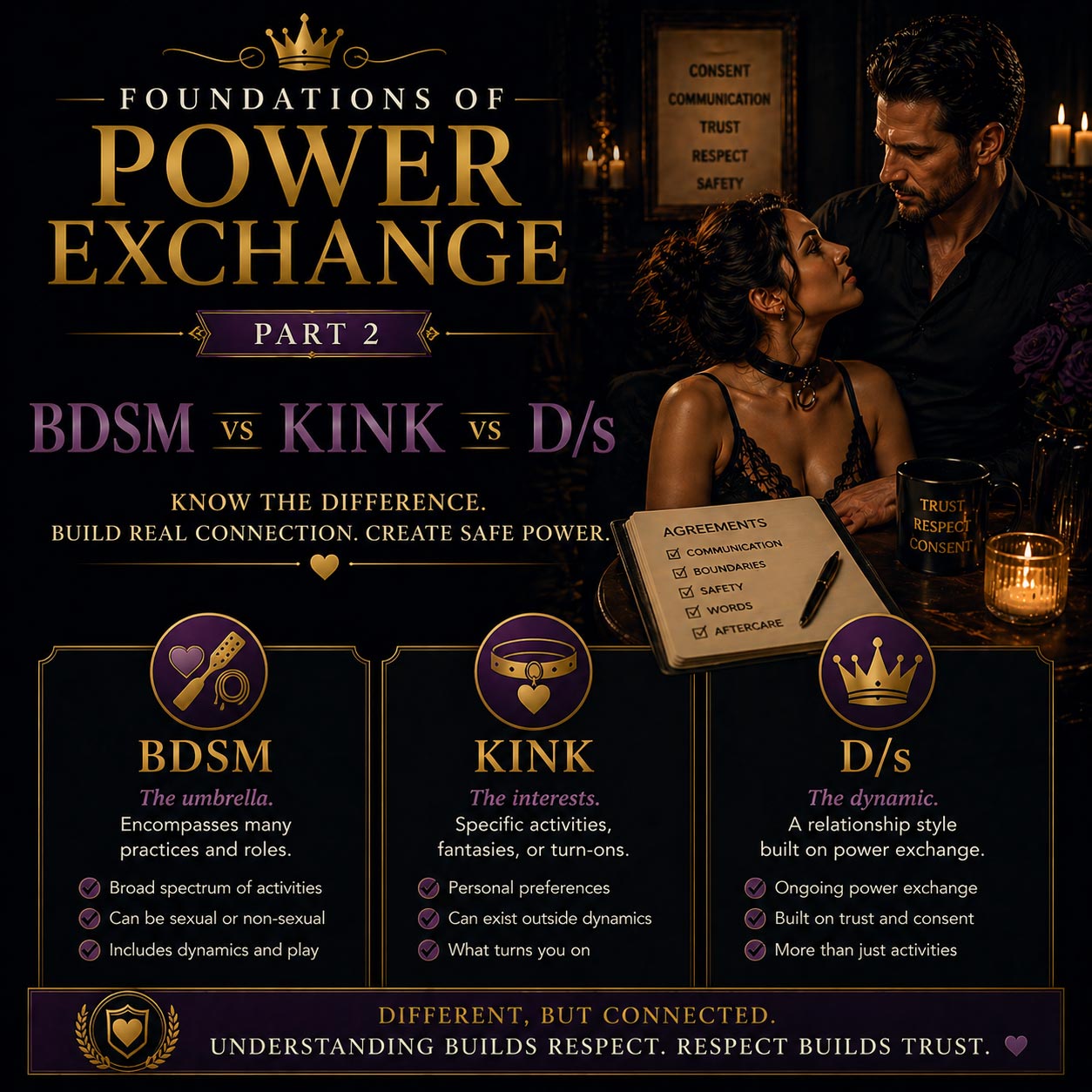
Kink is the widest and most flexible term of the three.
At its core, kink simply refers to interests, fantasies, or activities that exist outside what society traditionally labels as “vanilla” sexuality.
That could include an enormous range of things.
Bondage.
Impact play.
Role play.
Feet.
Leather.
Exhibitionism.
Power exchange.
Or countless other expressions of desire.
Some people have a single kink they enjoy occasionally.
Others have many.
For some people, kink is simply a fun element of intimacy they explore with a partner.
For others, it becomes a deeper part of their identity.
But kink itself does not automatically imply structure, roles, or authority.
It simply describes what someone enjoys.
This is why someone can absolutely be kinky without identifying with BDSM culture or wanting a D/s relationship.
Kink describes interests.
Not necessarily relationships.
BDSM: The Umbrella
While kink is a broad concept, BDSM is more of a community and activity umbrella.
The term itself combines several elements:
Bondage and Discipline
Dominance and Submission
Sadism and Masochism
These elements represent different types of play and interaction that often exist within kink spaces.
Someone might enjoy rope bondage.
Someone else might enjoy impact play.
Another person might enjoy sensation play or role-based scenes.
All of these activities can exist under the umbrella of BDSM.
But participating in BDSM activities does not automatically mean someone is practicing power exchange outside of scenes.
Many people in the BDSM community enjoy scene-based experiences.
They negotiate a scene.
They play.
And when the scene ends, the authority dynamic ends as well.
For them, BDSM is primarily about experiences and activities, not ongoing relational structure.
And that is perfectly valid.
D/s: The Relationship Structure
This brings us to the third concept.
Dominance and submission.
Or D/s.
While kink describes interests and BDSM describes a broader umbrella of activities and culture, D/s describes a relationship dynamic built on the intentional exchange of authority.
In a D/s dynamic, one partner chooses to lead.
The other chooses to surrender certain areas of decision making or control.
This exchange is built on trust, communication, and consent.
And unlike many BDSM scenes, D/s can extend beyond a single moment of play.
For some people, it becomes a lifestyle dynamic.
For others, it exists within specific agreed contexts.
But the defining feature of D/s is not the activities involved.
It is the structure of the relationship itself.
Power exchange becomes part of how the two partners interact.
Why This Distinction Matters
Understanding these differences can help new kinksters avoid one of the most common early mistakes.
Assuming that interest in kink automatically means wanting a D/s dynamic.
Many people enjoy kink activities without wanting authority structures in their relationships.
Others feel deeply drawn to power exchange and leadership dynamics.
Neither path is more valid than the other.
They are simply different.
And recognizing that difference can help you explore more intentionally.
Instead of asking:
“What should I be doing in BDSM?”
You can begin asking more meaningful questions.
Do I enjoy certain kink activities?
Am I drawn to the emotional structure of power exchange?
Do I want a dynamic that exists only within scenes, or one that extends into daily life?
Understanding where you fall on that spectrum allows you to build connections that align with your real desires rather than expectations you think you should follow.
Discovering Your Own Path
If you are new to the kink community, it is completely normal to feel uncertain about where you fit.
Many people spend time exploring before they fully understand their preferences.
You may discover that you love certain kinks but have no desire for D/s.
You may discover that power exchange resonates deeply with you.
Or you may find yourself somewhere in between.
All of those outcomes are valid.
The goal is not to rush into a label.
The goal is to learn, reflect, and explore responsibly.
And that exploration becomes much easier when you understand the language being used around you.
Because the clearer your understanding becomes, the easier it is to communicate honestly with potential partners.
And communication is the foundation of every healthy dynamic.
The Bigger Picture
In Part 1 of this series, we explored the concept of power exchange and what it actually means within D/s dynamics.
Now that you understand the difference between kink, BDSM, and D/s, the next step is to explore the most important principle that supports all of them.
Consent.
Because no matter which path someone chooses in the kink world, nothing works without it.
In the next article, we will explore why consent is not just a rule in BDSM.
It is the foundation that makes power exchange possible in the first place.
Foundations of Power Exchange Part 3: Consent Is the Foundation of Power Exchange
Understanding consent at a deeper level is one of the most important things any new kinkster can learn.
And it is where responsible exploration truly begins.
Call to Action
Where do you currently see yourself?
Are you primarily drawn to kink activities, the BDSM community, or the relationship structure of D/s?
Share your thoughts and experiences in the comments. Your perspective may help someone else who is still figuring out where they fit.