
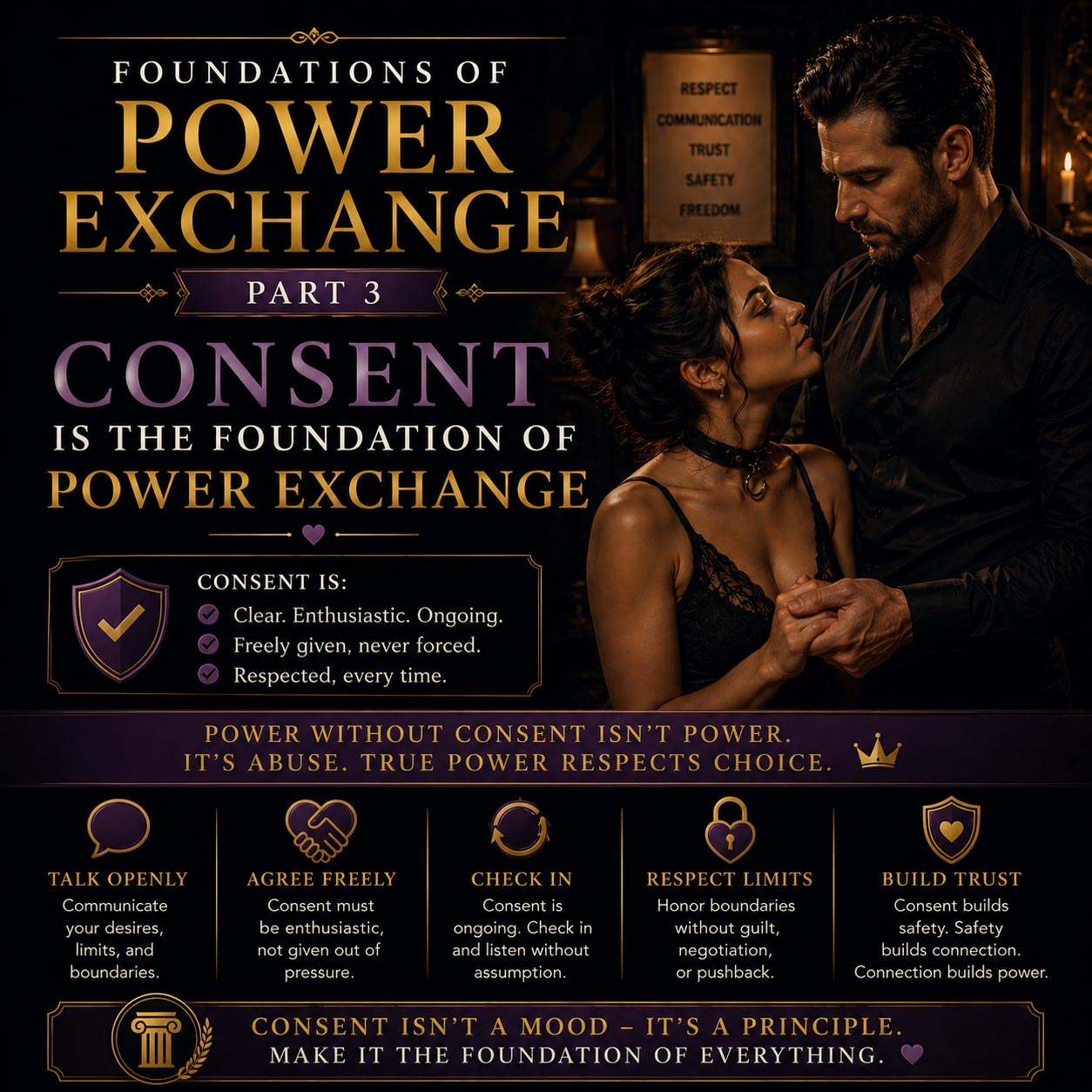
There is a word that sits quietly at the center of every healthy kink dynamic.
It is not dominance.
It is not submission.
It is not control.
The word is consent.
Without consent, BDSM does not exist.
Without consent, power exchange collapses.
Without consent, what remains is not kink.
It is something else entirely.
For people new to the kink world, consent may sound like a simple concept. Most of us understand the basic idea that both people must agree before something happens.
But in BDSM and D/s, consent is not just a moment.
It is a process.
It is a living agreement that grows, changes, and evolves as trust develops between partners.
Understanding this is one of the most important steps in building a safe and meaningful dynamic.
Consent Is What Makes Power Exchange Possible
At first glance, power exchange can appear paradoxical.
One person is leading.
Another person is surrendering control.
To an outside observer, that might look like imbalance.
But the reason healthy D/s works is because the exchange of authority happens through consent.
The submissive chooses to give authority.
The Dominant accepts responsibility for that authority.
Both people agree to the structure they are creating together.
This is why ethical power exchange is often described as consensual authority.
Nothing is forced.
Nothing is assumed.
Every step is negotiated.
And every partner maintains the right to adjust or withdraw consent at any time.
Consent is not what limits power exchange.
Consent is what makes it possible.
Enthusiastic Consent
One of the most important ideas in modern kink education is enthusiastic consent.
Consent should not exist as reluctant agreement.
It should not be pressure.
It should not be something someone says yes to because they feel obligated.
Healthy consent sounds more like this.
“Yes, I want that.”
“I’m excited to try that.”
“I trust you and I want to explore this together.”
Enthusiastic consent ensures that both partners are genuinely interested in what is happening.
It transforms a scene or dynamic from something being done to someone into something being created with someone.
And that difference changes everything.
Informed Consent
Consent also requires knowledge.
A person cannot truly agree to something if they do not understand what they are agreeing to.
That is why communication is so critical in BDSM.
Partners discuss boundaries.
Limits.
Experience levels.
Risks.
Emotional triggers.
Physical safety.
These conversations help ensure that each person understands the potential outcomes of what they are exploring.
This is often where concepts like SSC and RACK enter the conversation.
SSC stands for Safe, Sane, and Consensual. It emphasizes minimizing risk while ensuring all participants are capable of making informed decisions.
RACK stands for Risk Aware Consensual Kink. It acknowledges that some forms of play carry inherent risks but emphasizes that those risks are understood and accepted by informed participants.
Both frameworks share the same core idea.
People deserve to know what they are agreeing to.
Because knowledge strengthens consent.
Ongoing Consent
Another key principle of ethical BDSM is that consent is never permanent.
Even in long term dynamics.
Even in relationships that involve authority structures.
Consent must remain active.
Feelings change.
Comfort levels evolve.
Trust deepens or sometimes needs repair.
A scene that felt exciting one month may feel overwhelming later.
A boundary may shift.
A curiosity may grow.
Healthy dynamics make space for those changes.
Responsible Dominants regularly check in with their partners.
Submissives feel empowered to speak honestly about their needs.
These conversations are not signs that a dynamic is failing.
They are signs that the dynamic is alive and growing.
Communication Protects Everyone
Clear communication is one of the strongest safety tools in kink.
It protects submissives from being pushed beyond their comfort.
It protects Dominants from unknowingly crossing boundaries.
It strengthens trust.
And trust is the fuel that allows power exchange to deepen over time.
When communication is open and respected, partners can explore with confidence rather than fear.
This is why experienced members of the BDSM community often emphasize negotiation before play.
Discussing limits, expectations, and safewords creates a shared understanding that protects everyone involved.
It turns exploration into collaboration.
And collaboration is where the best dynamics are born.
Consent Creates Freedom
One of the most beautiful truths about consent in BDSM is that it actually creates freedom.
When two people communicate openly and trust each other’s boundaries, they gain the freedom to explore more deeply.
They know their partner is listening.
They know their safety matters.
They know they can stop if something feels wrong.
This safety allows vulnerability.
And vulnerability is where intimacy grows.
Power exchange thrives in environments where people feel secure enough to be fully themselves.
That security comes from consent.
Not control.
The Foundation We Build Together
If you take only one idea from this article, let it be this.
Consent is not a rule that limits kink.
Consent is the foundation that allows kink to exist safely and meaningfully.
It transforms power exchange from domination into partnership.
It protects both sides of the dynamic.
And it ensures that every step forward is taken together.
But consent alone is not enough to build a strong dynamic.
Even when two people agree enthusiastically, misunderstandings can still occur if communication and expectations are unclear.
That is why the next piece of this series explores another essential skill.
Understanding the difference between healthy authority, control, and abuse.
Because learning to recognize those differences protects everyone in the kink community.
Coming Next
In the next article, we will explore one of the most important safety discussions in BDSM.
How to distinguish ethical leadership from manipulation.
How to recognize when authority is being used responsibly.
And how to spot warning signs before harm occurs.
Foundations of Power Exchange Part 4: Authority vs Control vs Abuse
Understanding this distinction is one of the most powerful tools any kinkster can develop.
Call to Action
Take a moment to reflect on your own perspective.
What does consent look like in your ideal dynamic?
How do you communicate boundaries and trust with a partner?
Share your thoughts in the comments. Your insights may help someone else learning how to navigate power exchange safely.