
Who’s Vetting the Person Doing the Vetting?
Vetting Goes Both Ways We tell submissives to vet Dominants. Ask questions. Check references when appropriate. Watch behavior. Pay attention to boundaries. Look at communication. Notice how they

Vetting Goes Both Ways We tell submissives to vet Dominants. Ask questions. Check references when appropriate. Watch behavior. Pay attention to boundaries. Look at communication. Notice how they
Protocols and RSD RSD, or rejection sensitive dysphoria, describes intense emotional pain connected to perceived rejection, criticism, or disapproval. Inside D/s, that can be amplified. Especially when structure

Most dynamics believe they have structure because they have rules. Clear expectations.Defined boundaries.Agreements in place. On paper, everything looks solid. But emotionally, something still feels unstable. Especially in

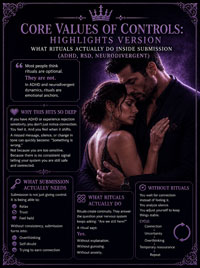
Most people use the words rules, rituals, and protocols like they mean the same thing. They do not. And when you confuse them, your dynamic suffers. Especially if

Trust is one of the most frequently used words in power exchange, yet it is rarely defined with clarity. People say “trust is everything,” but few take the

Many people focus on the beginning of a dynamic. The negotiation.The first scene.The excitement of discovering roles and connection. And while those moments matter, they are not what

Many people are drawn to power exchange because of how it feels. The intensity.The connection.The clarity of roles in a moment. And while those experiences can be powerful,

No matter how strong a dynamic is, there will be moments that feel uncomfortable. A boundary may shift.A scene may not go as expected.An emotional reaction may surface

One of the most common misconceptions about BDSM is that control means losing the ability to stop. That once a scene begins, the intensity takes over.That surrender means