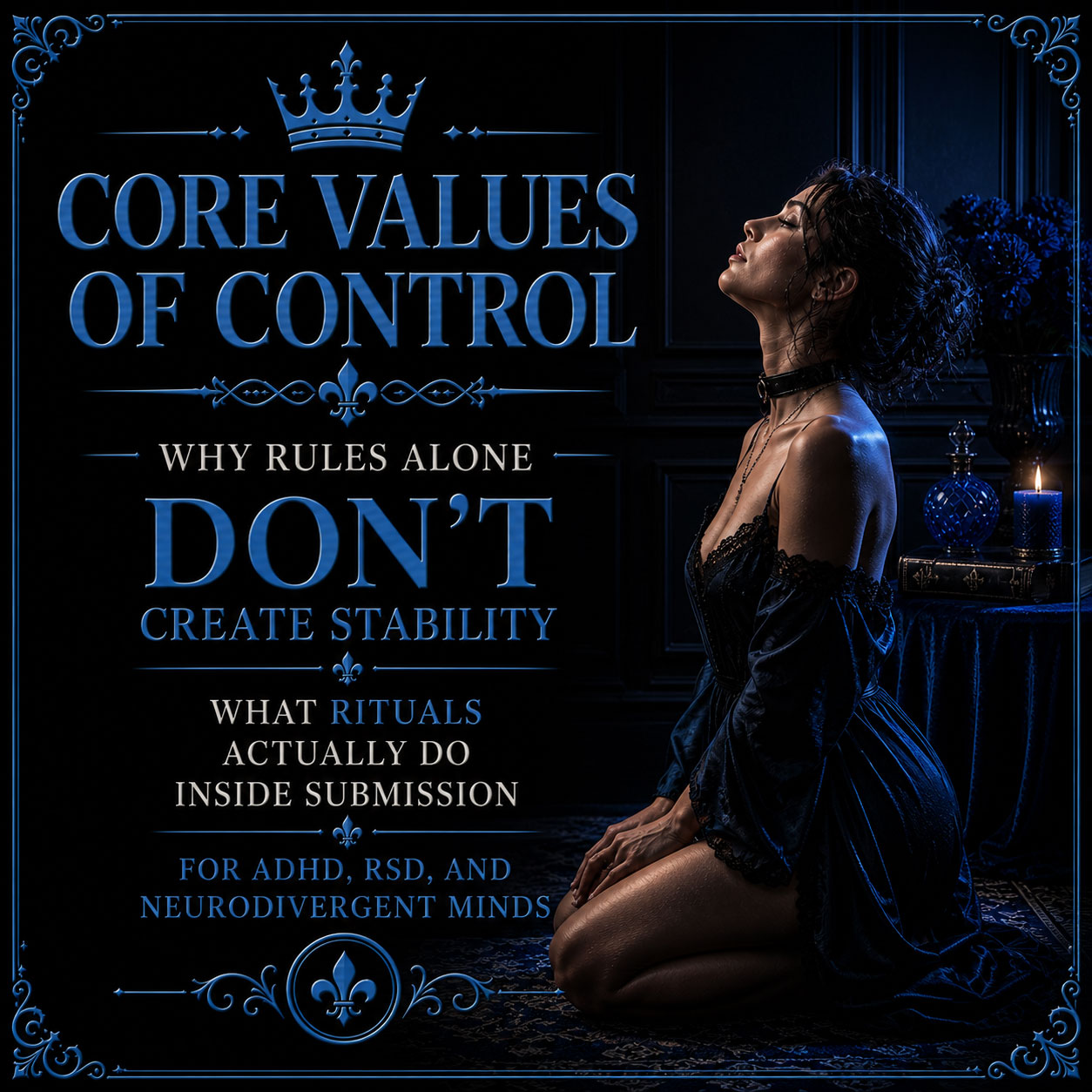
Most dynamics believe they have structure because they have rules.
Clear expectations.
Defined boundaries.
Agreements in place.
On paper, everything looks solid.
But emotionally, something still feels unstable.
Especially in ADHD and neurodivergent dynamics.
Because rules create clarity.
But they do not create connection.
And without connection, stability does not hold.
⸻
The Common Misunderstanding
Rules are often treated as the foundation of a dynamic.
“If we define expectations clearly, everything will work.”
And to a point, that’s true.
Rules answer:
What is expected
What is allowed
What matters
But they do not answer:
Are we still connected
Do I feel safe here
Can I relax into this dynamic
That is where many dynamics quietly struggle.
⸻
Why This Hits Harder with ADHD and RSD
If you have ADHD or experience rejection sensitivity, emotional continuity matters more.
Because your system is constantly scanning for:
Changes in tone
Breaks in pattern
Shifts in attention
A rule does not regulate that.
A rule does not say:
“I’m still here with you.”
So when there is silence, inconsistency, or a break in interaction, your mind fills in the gap.
And it rarely fills it with neutral thoughts.
It fills it with:
Doubt
Uncertainty
Self-questioning
Not because you are overreacting.
Because there is no emotional anchor present.
⸻
What Rules Actually Do (And Don’t Do)
Rules are necessary.
They create:
Clarity
Boundaries
Shared expectations
But rules operate at a logical level.
They tell you what should happen.
They do not make you feel that it is happening.
That distinction matters.
Especially in submission.
⸻
What Submission Actually Needs
Submission is not just about giving control.
It is about being able to:
Trust
Relax
Feel held within the dynamic
That does not come from knowing the rules.
It comes from feeling consistent connection.
Without that, submission turns into:
Overthinking
Emotional monitoring
Trying to interpret every interaction
Which becomes exhausting over time.
⸻
What Rituals Actually Do
Rituals create emotional continuity.
They answer a question your nervous system keeps asking:
“Are we still here?”
A ritual says:
Yes.
Without explanation.
Without guessing.
Without needing to ask.
That is what creates stability.
Not intensity.
Not rules.
Consistency of connection.
⸻
Why Rules Alone Fail in Real Dynamics
A dynamic may have rules like:
Check in regularly
Communicate clearly
Maintain consistency
But if there is no ritual defining how that happens, those rules rely on:
Memory
Energy
Focus
Mood
For ADHD and neurodivergent individuals, that creates inconsistency.
Not because they don’t care.
Because the system is incomplete.
The rule exists.
But the execution is unstable.
⸻
What This Feels Like from the Submissive Side
You may feel:
Clear about expectations
But unsure about connection
You know what is supposed to happen.
But you don’t feel it consistently.
That leads to:
Waiting for reassurance
Interpreting silence
Adjusting your behavior to maintain closeness
Over time, you start carrying emotional weight that structure should be holding.
⸻
What This Feels Like from the Dominant Side
You may feel:
Clear in your intentions
Frustrated by inconsistency
Confused why things still feel unstable
You may think:
“I’ve set the rules. Why isn’t this working?”
Because rules are only one part of structure.
Without rituals, the dynamic lacks continuity.
Without protocols, it lacks stability during disruption.
⸻
The Difference Between Clarity and Stability
Rules create clarity.
Rituals create continuity.
Protocols create stability.
Clarity alone is not enough.
You can understand a dynamic perfectly and still feel disconnected inside it.
Stability comes from repetition and predictability.
That is what rituals provide.
⸻
Why Rituals Matter More in Neurodivergent Dynamics
ADHD and RSD amplify:
Emotional intensity
Reaction to inconsistency
Difficulty trusting gaps
Rituals reduce that.
They create:
Predictable connection
Emotional anchoring
Reduced overthinking
They give your system something real to rely on.
Not something you have to interpret.
⸻
What Happens When Rituals Are Missing
Without rituals, many dynamics fall into a pattern:
Strong connection in moments
Disconnection in between
Reconnection through effort
Repeat
This creates:
Emotional fatigue
Uncertainty
A sense that the dynamic only exists sometimes
That is not a lack of care.
It is a lack of continuity.
⸻
What Changes When Rituals Exist
When rituals are defined and consistent, everything shifts.
The submissive stops guessing.
The Dominant stops relying on memory.
Connection becomes:
Predictable
Repeatable
Felt consistently
The dynamic no longer depends on perfect days.
It holds on average days.
That is stability.
⸻
The Missing Layer Most People Never Build
Most dynamics stop at rules.
Some add rituals inconsistently.
Very few build protocols.
But all three are required.
Rules define expectations.
Rituals maintain connection.
Protocols protect the dynamic during disruption.
Without all three, structure breaks under pressure.
With all three, the dynamic becomes sustainable.
⸻
The Truth Most People Avoid
If your dynamic feels:
Clear but inconsistent
Connected but unstable
Strong in moments but weak over time
The issue is not lack of desire.
It is incomplete structure.
Rules alone cannot hold a dynamic.
They were never meant to.
⸻
Call to Action
If this made you realize your dynamic has clarity but not stability, this is exactly where structure changes everything.
This is why I created:
Artifact 1: Rules, Rituals, and Protocols
The first layer of the Structure Blueprint System.
It is designed to help you:
Turn rules into consistent action
Create rituals that actually anchor connection
Build protocols that stabilize disruption
Support ADHD and neurodivergent consistency
Reduce emotional guesswork
Because a dynamic should not rely on memory, mood, or intensity.
It should have a structure strong enough to hold what you are building.
Join here:
https://orionsquill.com/products/
This is where the full system is being released and expanded.