Most people think rituals are just “nice extras” in a dynamic.
Something aesthetic.
Something symbolic.
Something optional.
They are not.
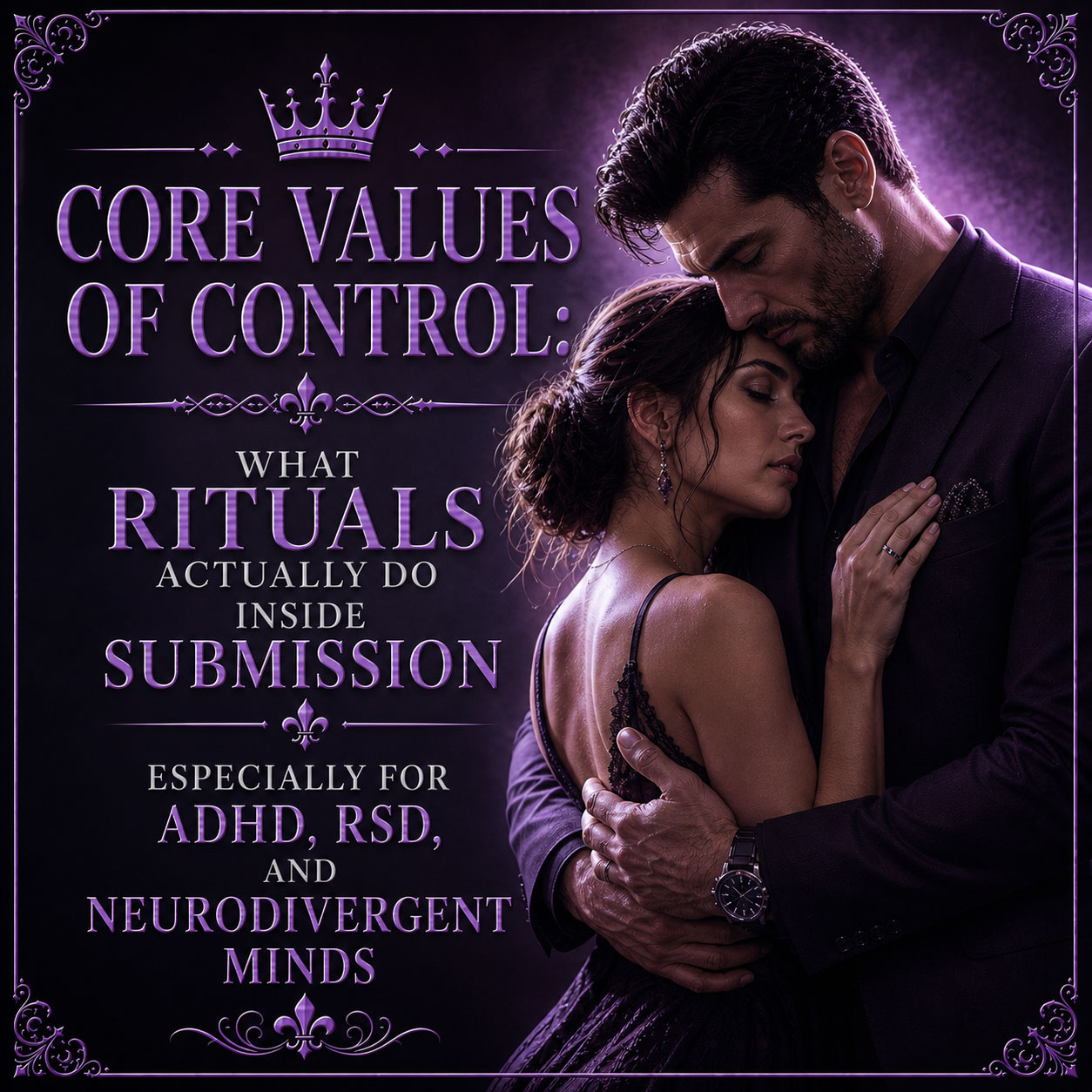
Especially in ADHD and neurodivergent dynamics, rituals are not decoration.
They are regulation.
They are anchoring.
They are one of the most powerful emotional stabilizers inside submission.
And when they are missing, something subtle but important begins to unravel.
⸻
Why This Feels So Intense for Neurodivergent Minds
If you have ADHD or experience rejection sensitivity, your emotional world likely has a different texture.
Connection can feel:
Deep
Immediate
Immersive
But disconnection can feel just as strong:
Sudden
Confusing
Personal
You may not just notice shifts in energy.
You feel them.
A missed message does not feel neutral.
A change in tone does not feel small.
A break in pattern does not feel incidental.
It can feel like:
Something changed
Something is wrong
Something is slipping
Even when nothing intentional happened.
⸻
The Emotional Reality of Submission
Submission is not just about giving control.
It is about emotional positioning.
It is about:
Trust
Safety
Consistency
Being able to rest inside the dynamic
Without that emotional stability, submission does not feel grounding.
It feels uncertain.
And uncertainty, especially with RSD, can quickly turn into:
Overthinking
Self-doubt
Emotional spiraling
Withdrawal or overgiving
Not because you are “too much”
But because there is nothing consistent enough to anchor to.
⸻
What Rituals Actually Do
Rituals create emotional continuity.
They answer a question your nervous system is constantly asking:
“Are we still here?”
A ritual says:
Yes.
Without needing explanation.
Without needing reassurance.
Without needing to chase clarity.
That is their power.
They are not about control.
They are about confirmation.
⸻
Why This Matters More with ADHD and RSD
ADHD and RSD often come with:
Inconsistent attention from others
Sensitivity to perceived changes
Difficulty trusting emotional stability
A tendency to fill in gaps with worst-case interpretations
So when a dynamic has no consistent rituals, the brain fills in the blanks.
And the blanks are rarely filled with neutral assumptions.
They are filled with:
Doubt
Fear
Uncertainty
Rituals interrupt that pattern.
They give your mind something real to hold onto.
⸻
The Difference Between Intensity and Stability
Many dynamics rely on intensity.
Strong moments.
Deep conversations.
Powerful scenes.
But intensity is not the same as stability.
Intensity spikes.
Stability holds.
Rituals are what create stability between intense moments.
They keep the connection from feeling like it only exists sometimes.
They make it feel continuous.
⸻
What Happens Without Rituals
Without rituals, many submissives experience:
Waiting for connection instead of feeling it
Interpreting silence as distance
Overanalyzing small changes
Trying to “earn” consistency through behavior
This leads to a cycle:
Connection
Uncertainty
Overthinking
Adjustment
Temporary reassurance
Repeat
It becomes exhausting.
And over time, it can create emotional fatigue inside the dynamic.
⸻
What Rituals Feel Like When They Work
When rituals are present and intentional, submission shifts.
It feels like:
Grounding instead of guessing
Connection instead of waiting
Security instead of questioning
You stop scanning for signs.
You stop trying to interpret everything.
You start feeling held in the dynamic, even in quiet moments.
That is the difference.
⸻
What Rituals Are Not
Rituals are not:
Random habits
Performative actions
Empty repetition
A ritual without meaning becomes noise.
A ritual with intention becomes anchoring.
The difference is purpose.
A ritual should answer:
What emotional need does this support?
If it does not support something real, it will not hold.
⸻
Examples of What Rituals Actually Do Emotionally
A simple check-in ritual can:
Reduce overthinking
Create predictability
Reinforce presence
A greeting ritual can:
Signal connection
Ground the dynamic at the start of interaction
Reduce uncertainty
A closing ritual can:
Provide emotional completion
Prevent lingering doubt
Create consistency
These are not small things.
They directly affect how safe submission feels.
⸻
Why “Just Communicate” Is Not Enough
Many people are told:
“Just communicate more”
But communication without structure becomes inconsistent.
And inconsistency is exactly what destabilizes neurodivergent dynamics.
Rituals are structured communication.
They remove the need to wonder:
Should I say something?
Is this the right time?
Am I asking for too much?
The system answers those questions for you.
⸻
The Hidden Impact on Dominants
This is not just about the submissive experience.
For a Dominant, especially one with ADHD, rituals reduce pressure.
They remove the need to:
Remember everything
Initiate every connection manually
Maintain constant emotional awareness
The ritual does part of the work.
It keeps the dynamic alive even when focus fluctuates.
That is not weakness.
That is intelligent structure.
⸻
Why Most Dynamics Get This Wrong
Most dynamics either:
Have no rituals
Have inconsistent rituals
Or confuse rituals with rules
They might say:
“We should check in more”
But that is not a ritual.
That is an idea.
A ritual is:
We check in every Sunday at 7pm with three set questions.
That is structure.
And structure is what makes rituals work.
⸻
Where This Connects to the Bigger Problem
If rituals feel inconsistent, unclear, or ineffective, it is rarely because rituals “don’t work.”
It is because the structure around them is incomplete.
Rituals are only one part of a larger system.
Without:
Clear rules
Defined rituals
Reliable protocols
The dynamic cannot stabilize long-term.
⸻
The Truth Most People Feel but Can’t Name
If you’ve ever felt:
Connected one moment and unsure the next
Safe during interaction but anxious in the gaps
Grounded in scenes but unsteady outside of them
You are not broken.
You are not too sensitive.
You are responding to inconsistency.
And your system is asking for something very specific:
Structure.
⸻
Why This Leads to the Solution
Rituals matter.
But rituals alone are not enough.
They need to exist inside a system that supports them.
That system includes:
Rules that define expectations
Rituals that maintain connection
Protocols that stabilize disruption
Without all three, the dynamic relies on emotional effort.
With all three, the dynamic becomes sustainable.
⸻
Call to Action
If this resonated, if you recognize the emotional patterns, the overthinking, the instability between moments of connection, this is exactly where structured dynamics change everything.
This is why I created:
Module 1: Rules, Rituals, and Protocols
The first layer of the structure blueprint system.
It is designed to help you:
Create rituals that actually anchor connection
Define expectations clearly
Build stability that works with ADHD and neurodivergent minds
Reduce emotional guesswork
Turn intense moments into consistent connection
Because submission should not feel like something you have to hold together on your own.
It should feel like something you can rest inside.
Join here:
https://OrionsQuill.com/Products/
This is where the full system is being released and expanded.