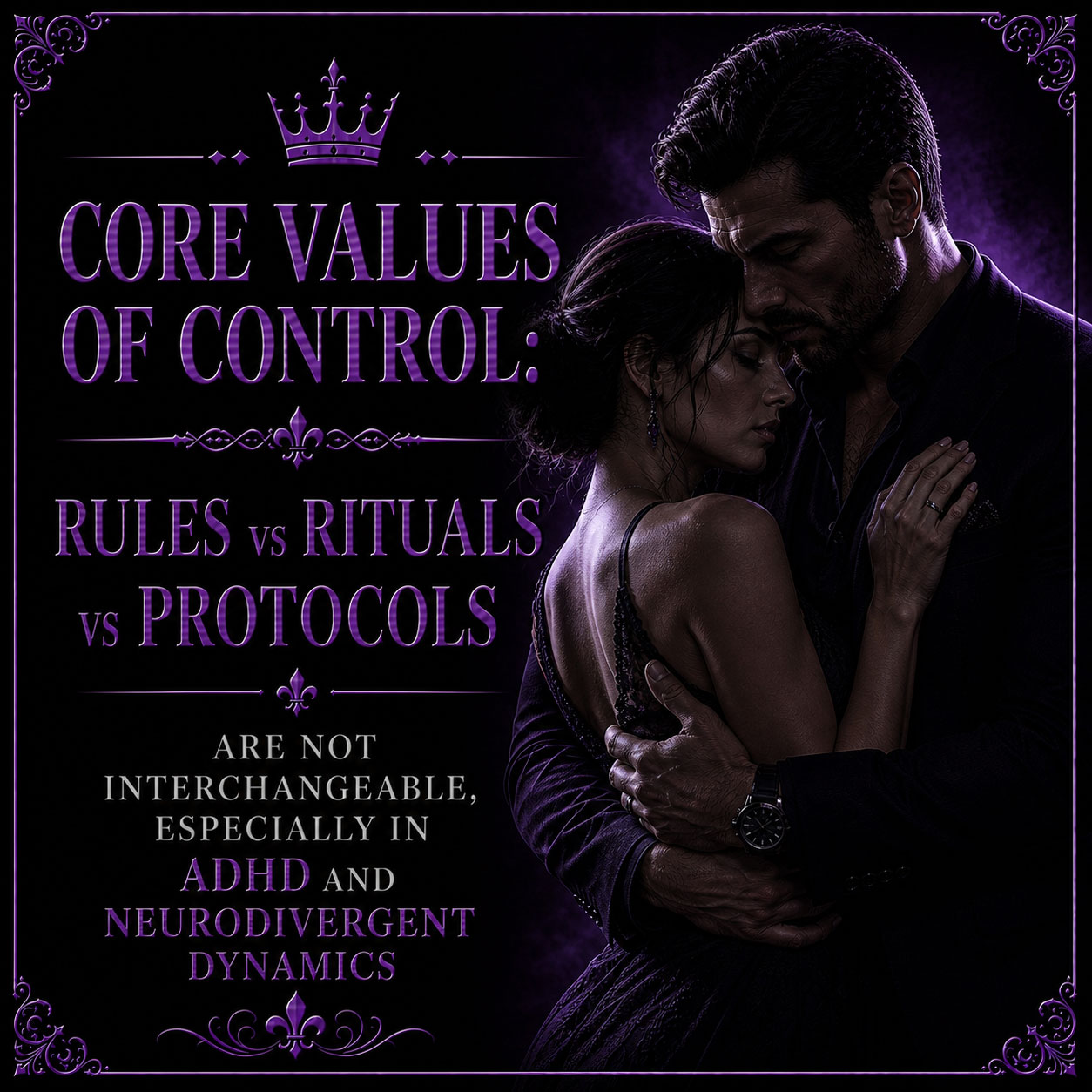
Most people use the words rules, rituals, and protocols like they mean the same thing.
They do not.
And when you confuse them, your dynamic suffers.
Especially if ADHD or neurodivergence is part of the relationship.
Because neurodivergent dynamics often do not struggle from lack of desire.
They struggle from lack of clarity.
They struggle because expectations are vague.
They struggle because consistency is assumed instead of built.
They struggle because one partner thinks something is a rule, the other experiences it as a ritual, and neither of them knows what happens when the system breaks.
That is where instability begins.
⸻
Why This Matters
In D/s, structure is not just decoration.
It is the framework that holds the dynamic together.
Without structure, everything depends on:
Mood
Memory
Energy
Focus
Emotional state
For ADHD and neurodivergent minds, that can become a problem fast.
Because intention may be strong, but follow through may fluctuate.
Connection may be real, but consistency may drift.
The desire to lead or submit may be present, but without a system, both partners end up guessing.
And guessing creates anxiety.
⸻
The Core Difference
Rules define expectations.
Rituals create connection.
Protocols guide behavior.
They are related.
But they are not interchangeable.
A rule says:
This matters.
A ritual says:
This connects us.
A protocol says:
This is how we do it.
When you understand the difference, structure becomes clearer.
When you do not, the dynamic becomes confusing.
⸻
What Rules Actually Are
Rules are agreed expectations.
They create boundaries around behavior.
They answer the question:
What is expected?
A rule might sound like:
Check in before making major dynamic changes
Use agreed titles during scene space
Communicate discomfort honestly
Complete assigned tasks by a certain time
No punishment without prior agreement
Rules create clarity.
They reduce ambiguity.
They tell both people what matters inside the dynamic.
For ADHD and neurodivergent people, this matters because vague expectations are easy to miss, misread, or forget.
A rule turns invisible expectation into visible agreement.
⸻
When Rules Go Wrong
Rules fail when they are:
Too vague
Too numerous
Too unrealistic
Too disconnected from actual needs
A rule like “be more consistent” is not useful.
Consistent how?
When?
With what behavior?
Measured by what standard?
A neurodivergent person may genuinely want to follow that rule, but still fail because the rule has no structure attached to it.
Better rule:
We will have a 10 minute check in every Sunday evening to review the dynamic.
That is specific.
That is measurable.
That can be supported.
A good rule should not create confusion.
It should remove it.
⸻
What Rituals Actually Are
Rituals are repeated actions that create meaning.
They answer the question:
How do we reconnect?
A ritual is less about enforcement and more about emotional anchoring.
A ritual might look like:
A morning good girl or good boy message
A kneeling moment before a scene
A nightly gratitude exchange
A collar touch before leaving the house
A weekly reset conversation
A specific phrase that marks the shift into dynamic space
Rituals tell the nervous system:
We are here.
We are connected.
This dynamic still exists.
For ADHD and neurodivergent dynamics, rituals can be powerful because they create rhythm.
They help both partners feel the dynamic even when life is chaotic.
⸻
When Rituals Go Wrong
Rituals fail when they are treated like rigid rules without understanding their purpose.
If a ritual is missed, the question should not always be:
Who failed?
Sometimes the better question is:
What broke the rhythm?
Was it overwhelm?
Was it burnout?
Was it forgetfulness?
Was the ritual too complicated?
Was it meaningful, or was it just performance?
A ritual should deepen connection.
If it becomes constant pressure, it needs to be adjusted.
Not abandoned.
Adjusted.
⸻
What Protocols Actually Are
Protocols are structured procedures.
They answer the question:
What do we do when this happens?
Protocols are especially important because they give the dynamic a path during stress, conflict, overwhelm, or transition.
A protocol might define:
How check ins happen
What to do after a missed task
How to pause a scene
How to reconnect after emotional flooding
How to handle low energy days
How to request clarification
How to repair after inconsistency
Protocols are not just about formality.
They are about stability.
For ADHD and neurodivergent people, protocols are essential because they reduce decision fatigue.
They prevent both partners from having to invent a response in the middle of overwhelm.
⸻
When Protocols Go Wrong
Protocols fail when they become too complex.
If a protocol requires perfect memory, perfect timing, or perfect emotional regulation, it will not work well for many neurodivergent dynamics.
A good protocol should be simple enough to use when stressed.
For example:
If either partner feels overwhelmed, they may call “pause.”
Both partners stop the discussion or scene.
They take 20 minutes apart or in quiet regulation.
They return and decide whether to continue, adjust, or close the moment.
That is a protocol.
It gives the dynamic a pathway.
It protects connection from becoming chaos.
⸻
Why ADHD Makes This Distinction Critical
ADHD often affects:
Executive function
Task initiation
Working memory
Emotional regulation
Time awareness
Consistency of follow through
This does not mean someone cannot lead.
This does not mean someone cannot submit.
It means the dynamic needs external structure.
Because without structure, the ADHD brain is forced to rely on internal consistency that may not always be available.
That is where shame enters.
The Dom feels like they are failing.
The sub feels like they are asking for too much.
Both people feel the gap, but neither knows how to name it.
The issue is often not desire.
It is structure confusion.
⸻
The Common Mistake
Many dynamics try to use one tool for every problem.
They create more rules when they actually need rituals.
They create rituals when they actually need protocols.
They create protocols when they have never defined the rules.
That is why things feel messy.
For example:
If the submissive feels disconnected, a new rule may not fix that.
They may need a ritual.
If the Dominant keeps forgetting check ins, a ritual alone may not fix that.
They may need a protocol.
If both partners disagree about what is expected, a protocol may not fix that.
They need rules.
Each tool has a job.
When you use the wrong tool, the dynamic keeps struggling.
⸻
How This Shows Up in Real Dynamics
A submissive says:
“I need more consistency.”
The Dominant hears:
“I am not doing enough.”
But what the submissive may actually mean is:
I need a clearer rule around check ins.
I need a ritual that helps me feel connected.
I need a protocol for what happens when plans change.
Those are three different needs.
If they are all treated as one vague complaint, nothing gets solved.
The dynamic becomes emotional instead of structural.
And once everything becomes emotional, both people start reacting instead of building.
⸻
The Neurodivergent Pattern Nobody Talks About
In ADHD and neurodivergent dynamics, there is often a cycle:
Intensity
Connection
Drift
Confusion
Guilt
Repair
Repeat
The dynamic starts strong.
Then structure fades.
Then one partner feels abandoned or unsupported.
The other feels criticized or overwhelmed.
Then both reconnect emotionally.
But if no structure changes, the cycle repeats.
That is why apology is not enough.
Desire is not enough.
Even love is not enough.
The system has to change.
⸻
Rules Create Clarity
Rules help both partners know what the dynamic expects.
They prevent assumptions.
They make the invisible visible.
A good rule should be:
Clear
Specific
Realistic
Mutually understood
Connected to a real purpose
Not every rule needs to be intense.
Some of the most powerful rules are simple.
Answer check in questions honestly.
Use safewords without hesitation.
Do not agree to something while emotionally flooded.
Ask for clarification instead of guessing.
These rules create safety.
And safety creates depth.
⸻
Rituals Create Consistency
Rituals help the dynamic feel alive.
They create rhythm.
They create emotional continuity.
For neurodivergent dynamics, rituals are often more useful when they are small.
A ritual does not need to be elaborate to matter.
A 30 second voice note can be a ritual.
A hand on the back of the neck can be a ritual.
A nightly message can be a ritual.
A weekly reset can be a ritual.
The power is not in complexity.
The power is in repetition with meaning.
⸻
Protocols Create Stability
Protocols protect the dynamic during disruption.
They are the fallback system.
They matter most when things are not ideal.
When someone forgets.
When someone shuts down.
When someone feels rejected.
When energy drops.
When emotion spikes.
When life interrupts the dynamic.
Protocols keep those moments from turning into collapse.
They give both partners a map.
And for ADHD or neurodivergent minds, a map can be the difference between repair and spiral.
⸻
Why This Leads Directly to Better Power Exchange
When rules, rituals, and protocols are clearly defined, both partners stop guessing.
The Dominant knows what they are responsible for.
The submissive knows what they can trust.
The dynamic stops depending on emotional intensity alone.
It becomes something built.
Something repeatable.
Something sustainable.
That is what most people are missing.
Not desire.
Not chemistry.
Not potential.
Structure.
⸻
The Difference Between Structure and Control
This is important.
Structure is not about making the dynamic colder.
It is not about removing emotion.
It is not about turning power exchange into a checklist.
Structure exists so emotion has somewhere safe to go.
It gives intensity a container.
It gives surrender a foundation.
It gives Dominance a system.
Without structure, control becomes inconsistent.
With structure, control becomes trustworthy.
⸻
If You Are a Dom with ADHD
This is not about shame.
This is about support.
You may have strong instincts.
You may be deeply capable.
You may know exactly how you want the dynamic to feel.
But if your structure is not clear, your partner may still experience instability.
That does not make you a bad Dom.
It means your Dominance needs a system that works with your brain instead of against it.
Rules help you define the standard.
Rituals help you maintain connection.
Protocols help you recover when consistency breaks.
That is leadership.
Not perfection.
Leadership.
⸻
If You Are a submissive in a Neurodivergent Dynamic
This is not about managing your Dom.
It is not your job to carry the entire structure alone.
But it is healthy to understand what kind of structure you need.
Do you need clearer expectations?
That is rules.
Do you need more consistent connection?
That is rituals.
Do you need a plan for when things go wrong?
That is protocols.
Naming the need clearly helps prevent resentment.
It also helps keep you from overfunctioning just to keep the dynamic alive.
⸻
The Question Every Dynamic Should Ask
Not:
Do we have structure?
But:
Do we know what kind of structure we are using?
Because rules, rituals, and protocols each solve different problems.
If your dynamic feels unclear, you may need rules.
If your dynamic feels disconnected, you may need rituals.
If your dynamic feels unstable during stress, you may need protocols.
Once you know the difference, you can stop guessing.
And start building.
⸻
The Truth Most People Miss
A rule is not a ritual.
A ritual is not a protocol.
A protocol is not a rule.
Confusing them creates frustration.
Defining them creates stability.
And in ADHD or neurodivergent dynamics, that clarity is not optional.
It is the difference between a dynamic that survives on good days and a dynamic that can hold through real life.
⸻
Call to Action
If this made you realize your dynamic has desire but not enough structure, that is exactly where the work begins.
This is why I created:
Module 1: Rules, Rituals, and Protocols
The first layer of the structure blueprint system.
It is designed to help you:
Define expectations
Create repeatable connection
Build fallback systems
Reduce confusion
Support neurodivergent consistency
Turn desire into something sustainable
Because a dynamic should not depend only on memory, mood, or motivation.
It should have a structure strong enough to hold what you are building.
Join here:
https://orionsquill.com/products/
The full structure blueprint system is being released in phases, and this is where the foundation begins.