
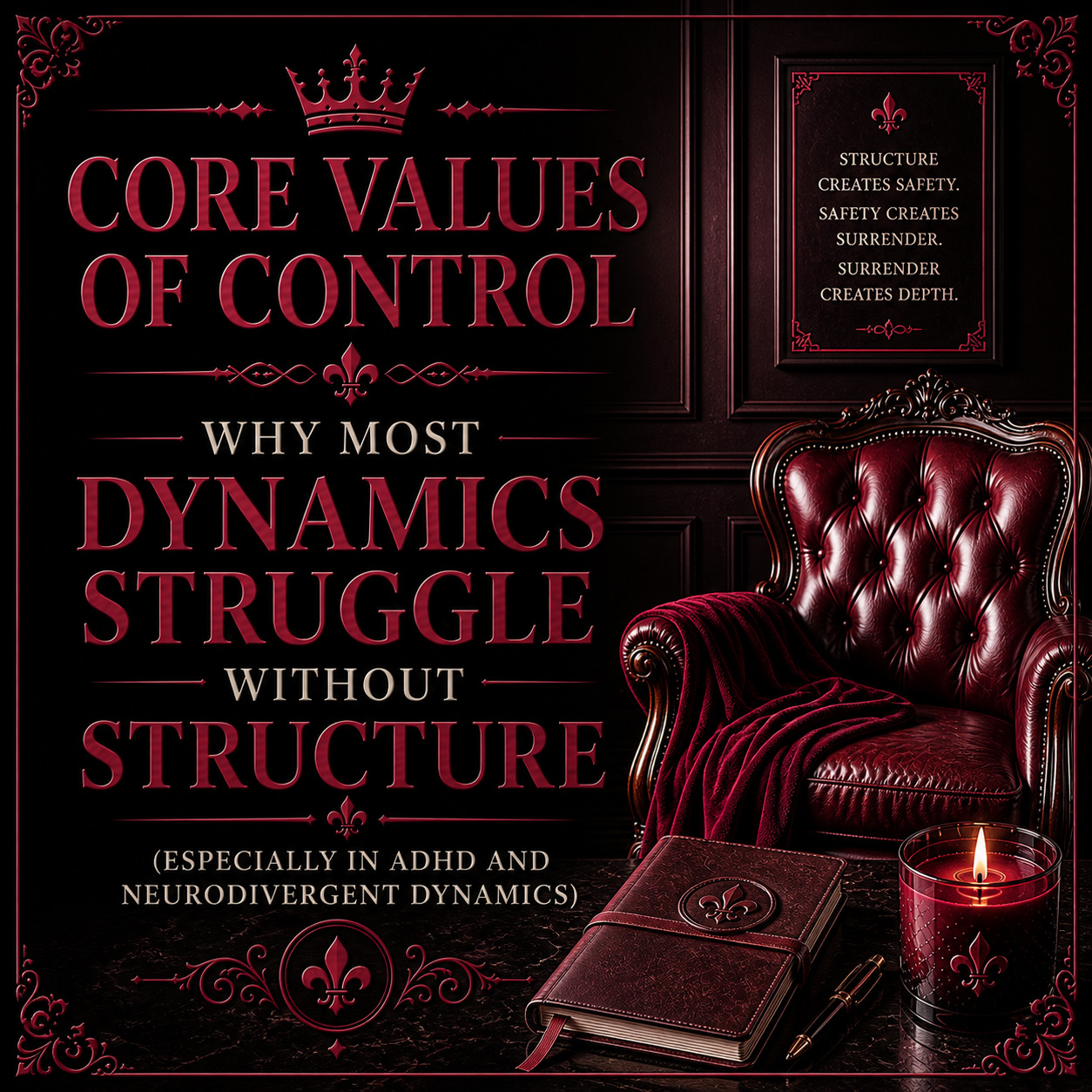
Most dynamics do not fail because of lack of desire.
They fail because nothing is holding them in place.
At the beginning, everything feels strong.
Clear.
Intentional.
Aligned.
There is connection.
There is chemistry.
There is direction.
And for a while, that feels like enough.
Until it isn’t.
⸻
The Slow Breakdown Most People Miss
The shift rarely happens all at once.
It happens gradually.
Check-ins become inconsistent
Expectations become less defined
Structure becomes dependent on mood
Nothing feels broken.
But everything feels slightly off.
And that subtle misalignment is where most dynamics begin to struggle.
⸻
Why This Happens More in ADHD and Neurodivergent Dynamics
In neurodivergent dynamics, especially those involving ADHD, this pattern becomes more pronounced.
Because the strengths are real:
Deep presence in moments
Emotional intensity
Strong connection
High engagement
But so are the challenges:
Inconsistent follow-through
Difficulty maintaining routine
Fluctuating focus
Emotional highs followed by drop-offs
This creates a dynamic that feels powerful in bursts…
But difficult to sustain.
⸻
The Core Issue: Intention Without Structure
Most people try to build dynamics on intention.
They rely on:
Desire
Communication
Effort
Connection
And while those things matter, they are not enough on their own.
Because ADHD does not respond consistently to intention.
It responds to structure.
Without structure, the dynamic becomes dependent on:
Memory
Energy
Focus
Emotional state
Which means consistency becomes unpredictable.
Not because either person lacks care.
But because there is no system supporting the dynamic.
⸻
What This Looks Like from Both Sides
From the Dominant’s side:
You may feel:
Clear in what you want
Strong in moments of leadership
Frustrated by inconsistency
You might start questioning yourself:
Why can I lead so well sometimes… but not maintain it?
From the submissive’s side:
The experience is different.
They may feel:
Uncertain where they stand
Unsure what to expect
Hesitant to fully surrender
Not because the connection is weak.
But because there is no consistent pattern to trust.
⸻
The Misinterpretation That Creates Tension
Without understanding this dynamic, both sides often misinterpret what is happening.
The Dominant thinks:
“I’m trying. Why isn’t this working?”
The submissive thinks:
“Something feels off. I don’t feel secure.”
This creates emotional friction.
Not because the dynamic is incompatible.
But because it is unsupported.
⸻
Why Most People Try to Fix the Wrong Thing
When things start to feel unstable, most dynamics try to compensate.
They:
Communicate more
Reassure more
Try to “understand each other better”
But without structure, these efforts do not hold.
Because the issue is not lack of communication.
It is lack of system.
⸻
What Structure Actually Does
Structure is not about control for the sake of control.
It is about stability.
It removes reliance on:
Memory
Mood
Motivation
And replaces it with:
Clarity
Consistency
Predictability
When structure exists, the dynamic no longer has to be rebuilt every day.
It holds itself.
⸻
The Three Elements Most Dynamics Are Missing
This is where everything shifts.
Rules
Rituals
Protocols
Rules create clarity so expectations are not guessed
Rituals create repetition so consistency does not rely on focus
Protocols create stability so the dynamic does not collapse during low-energy or distracted periods
Without these, the dynamic depends on your best moments.
With them, it works even when things are not perfect.
⸻
Why This Matters More in Neurodivergent Dynamics
For ADHD and neurodivergent individuals, this is not optional.
It is foundational.
Because structure:
Reduces cognitive load
Supports follow-through
Creates external consistency
It allows both partners to:
Stop guessing
Stop adapting constantly
Start trusting the dynamic
This is what makes surrender possible.
And what makes leadership sustainable.
⸻
What Changes When Structure Is Introduced
When a dynamic has real structure:
The Dominant does not have to rely on memory or energy to lead
The submissive does not have to rely on hope to feel secure
Consistency becomes something both people can feel.
Not something they have to question.
⸻
The Truth Most People Avoid
The problem is not ADHD.
The problem is trying to build a dynamic without structure around it.
Because ADHD does not remove the ability to connect, lead, or submit.
It removes the ability to rely on intention alone.
⸻
If This Feels Familiar
If your dynamic feels:
Strong but inconsistent
Connected but unstable
Clear in moments but unclear over time
You are not alone.
And you are not failing.
You are missing structure.
⸻
Call to Action
This is exactly why I built the first layer of my system:
Artifact 1: Rules, Rituals, and Protocols
Not as theory.
But as a way to:
Create clarity
Build consistency
Stabilize the dynamic in a way that works with neurodivergent minds
So your dynamic becomes something you can actually live inside.
[Click here to starting building structures properly]
This is where the full system is being released and expanded.