One of the most important skills anyone entering the world of kink must develop is the ability to recognize different forms of power.
From the outside, authority, control, and abuse can sometimes appear similar.
Someone gives orders.
Someone follows them.
Power is exchanged.
But the reality inside ethical BDSM is very different.
The source of the power is what defines whether a dynamic is healthy or harmful.
Understanding the difference between authority, control, and abuse is not just an academic discussion. It is a core safety skill for anyone exploring power exchange.
If you cannot recognize the difference, it becomes much harder to protect yourself or someone who trusts you.
And for those who wish to hold authority in a D/s dynamic, understanding this distinction is part of the responsibility that comes with that role.
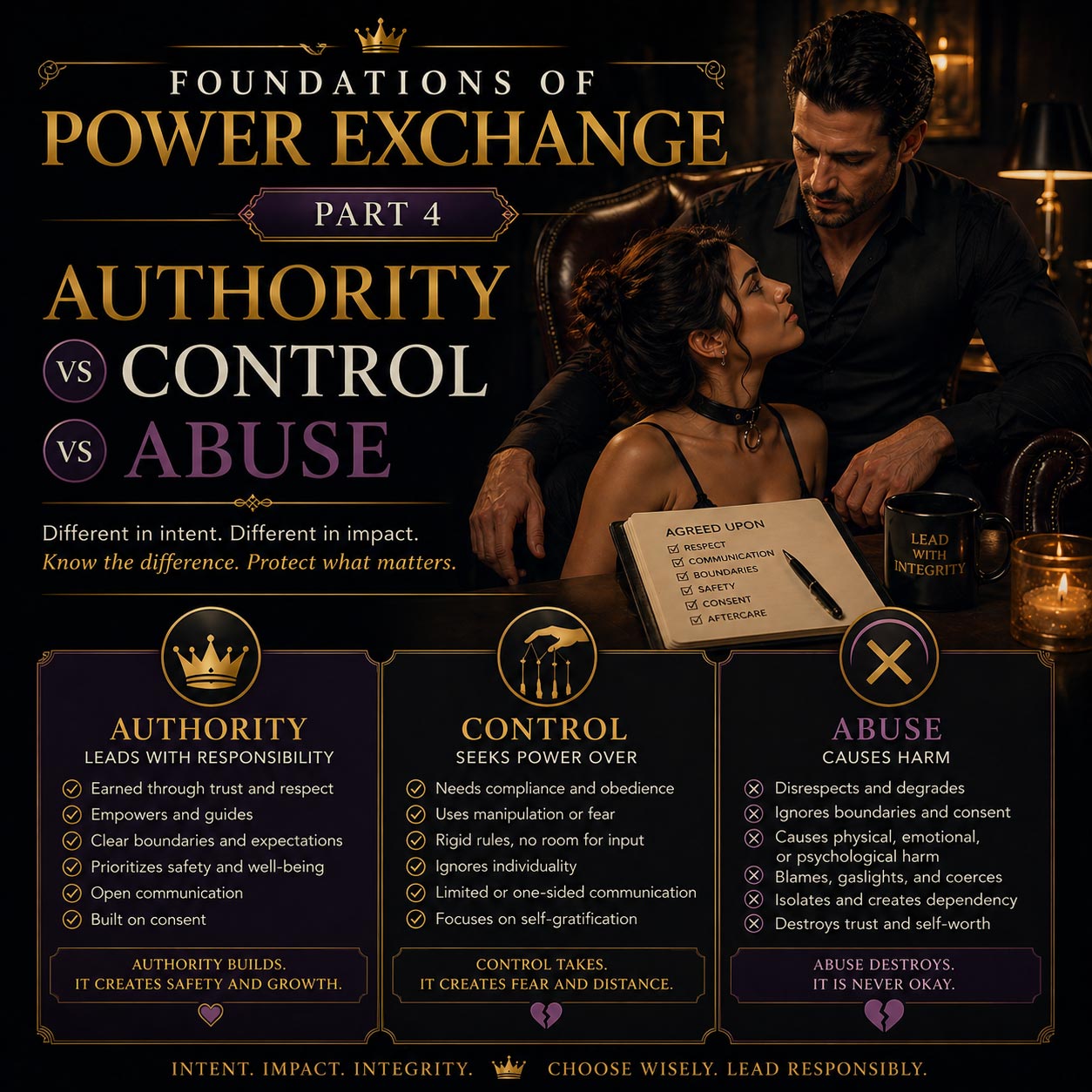
Authority: Power That Is Given
In ethical BDSM, authority is never taken.
It is granted.
Authority exists when a submissive consciously chooses to trust a Dominant and willingly offers them influence within a negotiated space.
That authority is built on three essential elements.
Consent.
Communication.
Respect.
Without those elements, authority cannot exist.
An ethical Dominant does not assume power over another person. They are trusted with it.
That trust creates responsibility.
True authority rarely needs to be loud or forceful. It does not rely on threats or intimidation.
Instead it is steady, consistent, and protective.
Experienced Dominants understand something that many beginners miss.
The submissive holds the ultimate power.
Because the moment consent is withdrawn, the authority disappears.
Authority exists only as long as both people continue to choose the dynamic together.
And that is what makes ethical power exchange possible.
Control: Structure Within Agreed Boundaries
Control is another word that is often misunderstood when people first encounter BDSM.
In healthy dynamics, control is not about dominating someone’s life without limits.
It is about creating structure inside agreed boundaries.
Control may take many forms.
Rules.
Rituals.
Protocols.
Behavioral expectations.
These structures can give a dynamic rhythm and meaning. They can deepen trust and reinforce the shared roles within the relationship.
But every element of control should exist because both partners agreed to it beforehand.
Healthy control always includes safeguards.
Safewords or signals that allow someone to pause or stop.
The ability to renegotiate limits as trust grows.
Emotional check ins between partners.
Aftercare and responsibility following intense scenes.
These elements protect both partners and keep the dynamic grounded in mutual respect.
When control exists within these negotiated boundaries, it becomes a container where exploration can happen safely.
Without those safeguards, something important is missing.
Abuse: Power Taken Without Consent
Abuse is not BDSM.
Abuse occurs when someone removes consent, autonomy, or safety in order to maintain power over another person.
Where authority is granted and control is negotiated, abuse is taken.
Abuse can appear in many forms.
Ignoring safewords.
Pushing boundaries without discussion.
Isolating someone from friends or community.
Demanding obedience without negotiation.
Manipulating fear, guilt, or emotional dependence.
Sometimes abuse hides behind the language of BDSM.
Someone may claim that “real submission” requires blind obedience.
Or that questioning authority means someone is not truly submissive.
But ethical Dominants understand something very simple.
Power exchange without consent is not dominance.
It is exploitation.
Healthy BDSM exists only when both partners maintain agency, communication, and safety.
Remove those elements and the dynamic stops being power exchange.
Recognizing Red Flags
One of the best ways to protect yourself in the kink world is to recognize early warning signs.
Pay attention if someone discourages questions or avoids negotiation.
Notice if they push boundaries quickly without building trust.
Be cautious if they reject the idea of safewords or safety planning.
Anyone who claims that consent is unnecessary in “true submission” is ignoring one of the core principles of ethical BDSM.
Healthy Dominants welcome communication.
They respect boundaries.
They understand that a submissive’s safety and autonomy are essential parts of the dynamic.
Strong power exchange is built through trust, not pressure.
And trust grows through honest conversation.
The Responsibility of Power
Ethical power exchange is not about controlling someone.
It is about holding power responsibly.
Dominants who approach the role with integrity understand that authority must be earned through behavior.
Consistency.
Empathy.
Communication.
Accountability.
These qualities create the environment where submission can feel safe and meaningful.
Submissives, in turn, bring their own strength into the dynamic.
Choosing to trust someone with vulnerability requires courage.
When that courage meets responsible leadership, something powerful can develop.
A connection built on trust can deepen in ways many people never experience in traditional relationships.
But it only works when the foundation remains ethical.
Consent must remain present.
Respect must remain mutual.
And power must always be handled with care.
Coming Next
In the next article in this series, we will explore another important piece of the foundation.
Many people assume that Dominance is simply about confidence or authority.
In reality, the role carries significant emotional responsibility.
What does ethical leadership actually look like in a D/s dynamic?
What responsibilities come with holding authority over another person?
These questions are at the heart of the next piece in this series.
Foundations of Power Exchange Part 5: What Healthy Dominance Actually Looks Like
Understanding this responsibility is one of the most important steps anyone interested in power exchange can take.
Call to Action
Take a moment to reflect on your own understanding of power.
What qualities do you believe define ethical authority in a D/s dynamic?
Share your thoughts in the comments. Your perspective may help someone else learning how to navigate power exchange safely.