
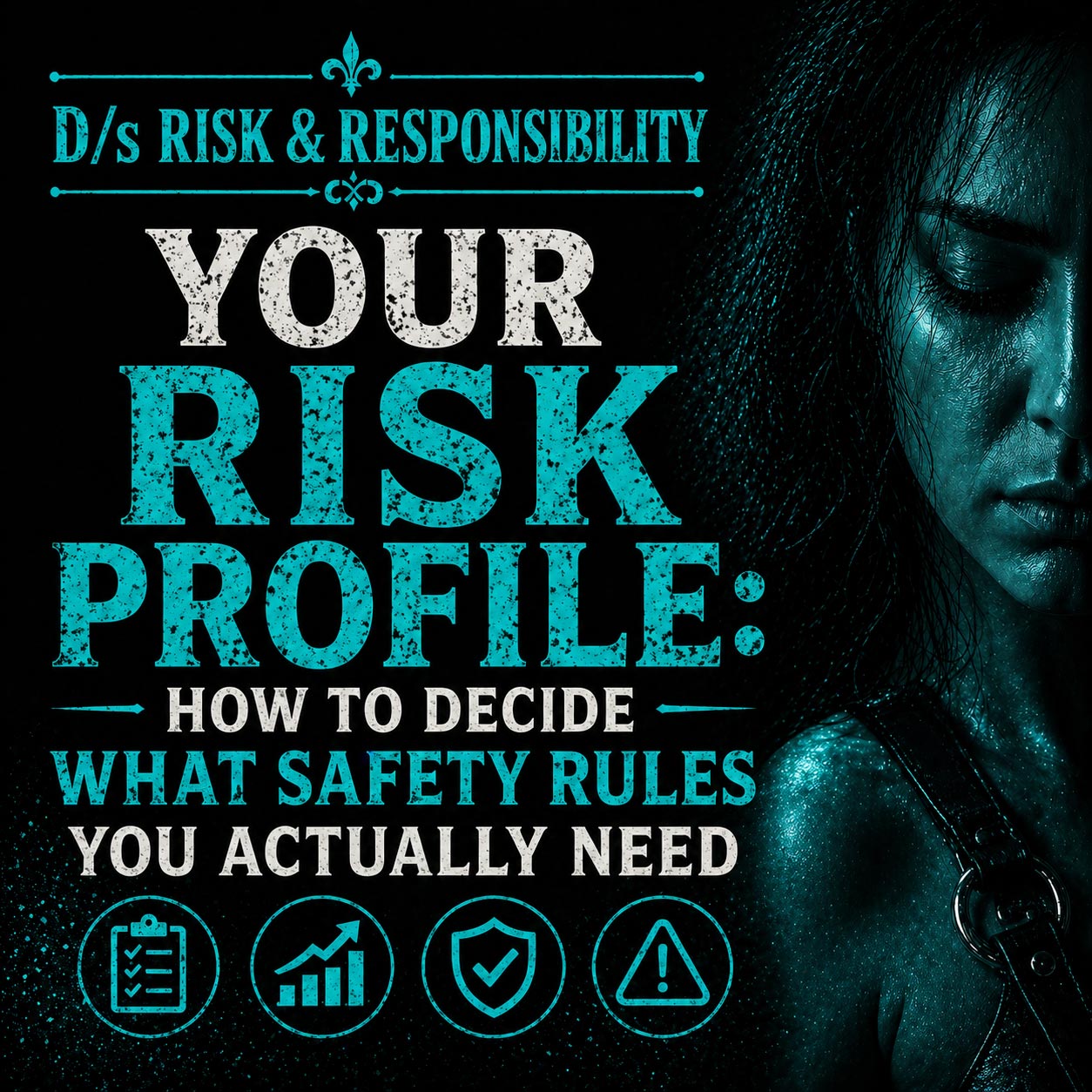
In the first article, we established a truth: BDSM is never 100 percent safe.
Now comes the more uncomfortable question.
Safe according to whom?
Because what feels manageable to one Dominant may feel reckless to another.
What feels thrilling to one submissive may feel destabilizing to someone else.
This is where your risk profile comes in.
⸻
What Is a Risk Profile?
Your risk profile is your personal tolerance for vulnerability, exposure, physical intensity, emotional depth, and public visibility.
It is shaped by:
• Your life circumstances
• Your career and family realities
• Your mental health
• Your trauma history
• Your medical status
• Your experience level
• Your support system
• Your emotional resilience
Two people can negotiate the exact same scene and have completely different acceptable risk levels.
Neither is wrong.
But pretending they are the same is dangerous.
⸻
Dominant Risk Profiles
Dominants often underestimate their own risk exposure.
Risk for a Dominant is not only physical. It includes:
• Legal risk
• Reputation risk
• Emotional responsibility
• Psychological harm if a submissive destabilizes
• False accusation potential
• Skill based injury risk
Holding authority increases responsibility. It does not reduce vulnerability.
A Dominant with a high risk profile may:
• Prefer public play spaces
• Require written negotiations
• Avoid intoxicated scenes
• Refuse breath play or edge play
• Require references before private meetings
That is not insecurity. That is structure.
⸻
Submissive Risk Profiles
Submissives often carry layered risk that goes beyond the scene.
• Risk of being outed
• Risk of emotional attachment
• Risk of financial vulnerability
• Risk of dependency
• Risk of freezing instead of safewording
• Risk of misjudging a Dominant’s competence
Submission does not erase self responsibility.
A submissive with a lower risk tolerance may:
• Only play in public
• Use safe calls
• Avoid heavy bondage initially
• Refuse overnight stays early
• Require multiple non play meetings first
That is not fear. That is discernment.
⸻
Why Comparing Risk Profiles Is Dangerous
One of the fastest ways people override their instincts is comparison.
“They are comfortable with it.”
“Other submissives do this.”
“Experienced Dominants do not worry about that.”
None of that matters.
Your nervous system does not care what someone else tolerates.
Your life consequences do not transfer to someone else.
Risk is personal.
And maturity in D/s means honoring that without apology.
⸻
Building Safety Rules Around Your Profile
Instead of copying rules from others, ask:
What would truly destabilize me?
What would damage my career, family, or reputation?
What would overwhelm my nervous system?
What would I struggle to recover from emotionally?
What physical risks am I realistically trained to manage?
From there, build your safety structure.
Maybe that means:
• No private first meetings
• No intoxicated scenes
• No play without dungeon monitors
• No sexual contact in early negotiations
• No travel without references
• No 24 7 dynamic without months of vetting
Your rules are not an audition.
They are protection.
⸻
Risk Profiles Change
Your profile today is not your profile forever.
As skill increases, confidence grows.
As trust deepens, tolerance expands.
As trauma heals, flexibility increases.
Or sometimes the opposite happens.
A painful experience may reduce tolerance.
A life change may increase risk exposure.
A career shift may require stricter privacy.
Re evaluate regularly.
Dominance evolves.
Submission evolves.
So should your boundaries.
⸻
The Mature Dynamic
When two people exchange power responsibly, they do not push each other to match risk tolerance.
They align.
A Dominant who pressures a submissive to accept more risk is not demonstrating authority. They are demonstrating impatience.
A submissive who hides discomfort to appear resilient is not demonstrating devotion. They are compromising self protection.
Compatibility in D/s is not just kink alignment.
It is risk alignment.
⸻
Why This Matters
When you know your risk profile:
You negotiate from clarity.
You filter partners faster.
You avoid unnecessary exposure.
You stop mistaking pressure for chemistry.
You stop apologizing for caution.
Risk awareness is not restrictive.
It is stabilizing.
And stability makes intensity sustainable.
⸻
Call To Action:
Before your next negotiation, write down three non negotiable safety rules based on your real life consequences, not fantasy expectations.
Then ask your potential partner to do the same.
Alignment begins there.