Self Collaring, Collaring Ceremonies, and What the Symbol Actually Means
There are objects in BDSM that can carry considerably more meaning than their physical form suggests.
A collar is one of them.
To someone outside the lifestyle, it may simply look like something worn around the neck.
Inside BDSM, it can mean something entirely different.
Identity.
Commitment.
Belonging.
Power exchange.
Responsibility.
Submission.
Ownership, when consensually defined that way.
A relationship milestone.
Or sometimes something deeply personal that has nothing to do with belonging to another person at all.
That last one deserves more conversation.
Because not every collar is given by a Dominant.
Sometimes someone collars themselves.
And understanding why leads us into a much larger conversation about what collars actually mean, what they do not mean, and what should exist before a collar ever closes around someone’s neck.
There Is No Universal Meaning of a Collar
Let’s begin here because collar discussions can become surprisingly rigid.
There is no single meaning every BDSM community, relationship, or individual assigns to a collar.
For one person, a collar may be primarily aesthetic.
For another, it represents their identity as a submissive.
For another couple, it functions similarly to a relationship commitment.
Someone else may associate different collars with different stages of a dynamic.
Others may never use collars at all.
Even within established BDSM communities and traditions, the symbolism attached to collars can vary.
That matters.
Because sometimes we become so invested in what a symbol means to us that we assume it must mean exactly the same thing to everyone else.
It doesn’t.
None of those differences automatically make one person’s BDSM more authentic than another’s.
Symbols become powerful because of the meaning people intentionally place inside them.
And that is particularly important when discussing self collaring.
What Is Self Collaring?
Self collaring is exactly what it sounds like.
Someone chooses a collar for themselves and intentionally gives that collar personal meaning.
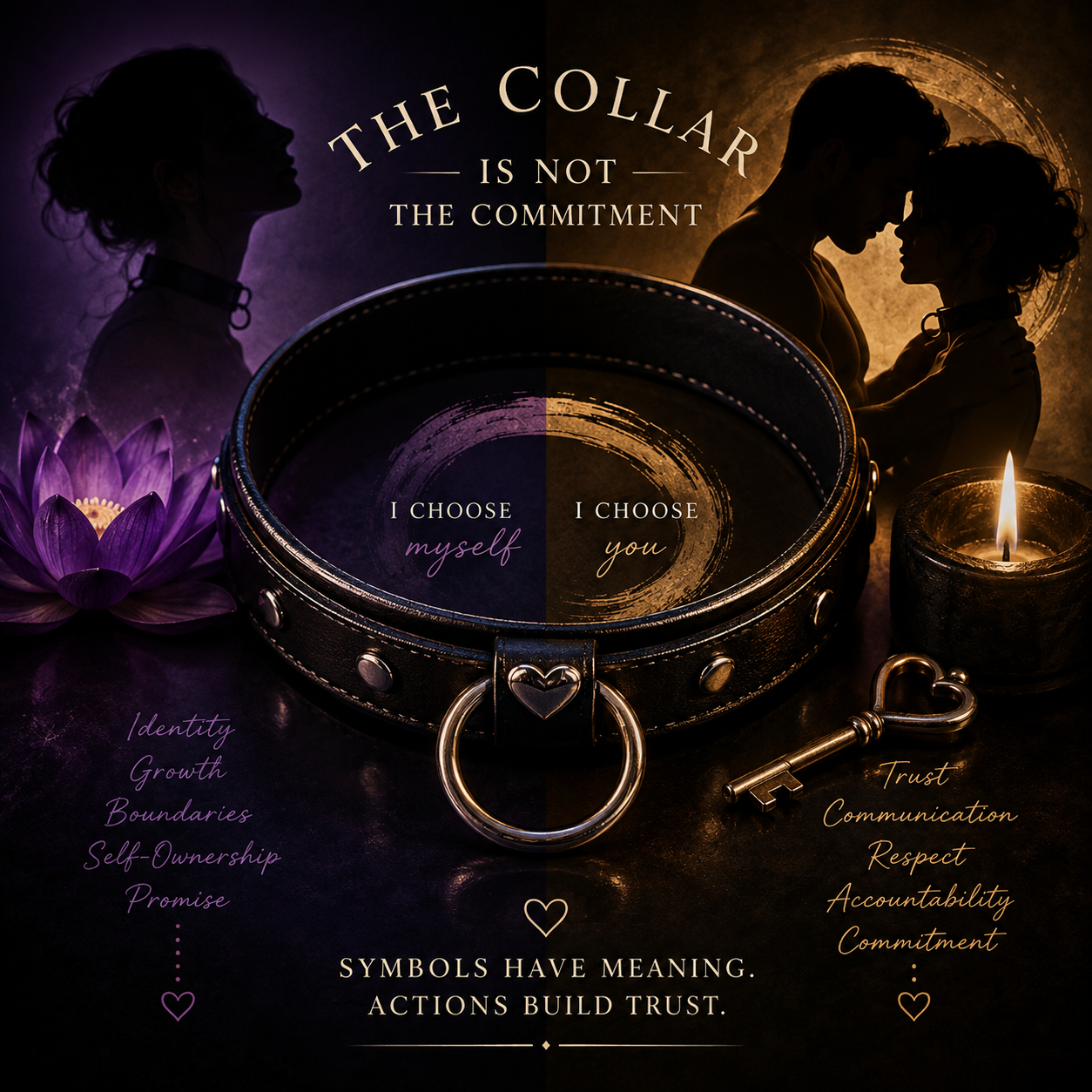
It can represent self ownership.
Recognition of one’s submissive identity.
Personal discipline.
Commitment to personal growth.
A promise to protect one’s own boundaries.
A period of intentional independence.
A personal ritual marking a new chapter.
Or a decision that their submission belongs to them until they consciously choose to share it with someone else.
For some people, the message behind a self collar might be:
My submission belongs to me. I decide when, how, and with whom I share it.
That is a powerful distinction.
Because there is a difference between being submissive and being someone’s submissive.
A person doesn’t require a Dominant to validate the first.
And perhaps that distinction becomes particularly important for someone who is still learning what submission means to them.
You Don’t Need Someone Else to Give Your Identity Meaning
Sometimes people enter BDSM believing they need another person before their identity becomes legitimate.
A submissive needs a Dominant.
A Dominant needs a submissive.
Someone isn’t “really” part of the lifestyle until they have a dynamic.
I don’t think identity needs to work that way.
Someone can explore submission while single.
They can study communication.
Learn their boundaries.
Understand their emotional and physical needs.
Explore what service means to them.
Consider what obedience means to them and whether they want it at all.
Examine what kind of authority they might eventually want to surrender.
Learn what healthy Dominance looks like.
Learn what unhealthy Dominance looks like.
Explore their attachment patterns, expectations, fantasies, fears, desires, limits, and relationship needs.
And perhaps most importantly, they can decide what standards someone will eventually need to meet before receiving access to their submission.
That period does not have to be viewed as waiting for someone else to arrive.
It can be preparation.
A self collar can become a physical reminder of that work.
Not:
Nobody owns me.
But perhaps:
I belong to myself first.
And because I do, I get to decide what I eventually share.
A Self Collar Can Be a Promise
This is where self collaring becomes particularly interesting to me.
Imagine someone creating their own private collaring ceremony.
No audience.
No Dominant.
No announcement required.
They place the collar around their own neck and make promises.
I will listen when my instincts tell me something is wrong.
I will not abandon my boundaries simply because I want connection.
I will communicate honestly.
I will continue learning.
I will not confuse intensity with safety.
I will remember that submission is something I choose rather than something another person is entitled to receive.
I will not surrender myself simply because someone asks beautifully.
Those promises could be entirely different for another person.
Perhaps the self collar represents healing after a relationship.
Perhaps it marks a period of intentional singleness.
Perhaps it represents recommitting to personal standards after recognizing that they had repeatedly compromised themselves for connection.
Perhaps it simply celebrates an identity they finally understand.
There is no required ceremony.
There is no approved set of vows.
There doesn’t even need to be a ceremony at all.
The significance comes from intention.
Now the collar isn’t representing the absence of a relationship.
It represents a relationship that already exists.
The relationship someone has with themselves.
Then There Is the Collar Given Between People
This is where the symbolism can change significantly.
A collar exchanged within a D/s relationship may represent an intentional shift.
Perhaps authority has deepened.
Perhaps the relationship has reached a particular milestone.
Perhaps responsibilities are changing.
Perhaps both people have decided to formalize what already exists between them.
And sometimes that moment becomes a collaring ceremony.
The important word there is already.
Because ideally, the ceremony isn’t creating something out of nothing.
It is recognizing something the people involved have already spent time building.
Trust.
Communication.
Compatibility.
Consistency.
Negotiated authority.
Mutual understanding.
A collar can mark that development beautifully.
But it cannot replace it.
The Ceremony Should Not Be More Important Than What Came Before It
This is where I want to challenge some of the romance surrounding collaring.
Collaring ceremonies can be beautiful.
They can be elaborate.
Private.
Public.
Formal.
Playful.
Traditional.
Entirely invented by the people involved.
There might be vows.
Promises.
Rituals.
Witnesses.
A special location.
Meaningful clothing.
Music.
A particular collar chosen together.
Or simply two people sitting somewhere important to them and acknowledging what their relationship has become.
All of those things can make the moment unforgettable.
But none of them make the relationship healthy.
A ceremony can symbolize trust.
It cannot manufacture it.
Your collar doesn’t suddenly make someone reliable.
It doesn’t make communication healthy.
It doesn’t create compatibility.
It doesn’t turn control into leadership.
It doesn’t make boundaries safe to express.
It doesn’t create accountability.
It doesn’t guarantee emotional safety.
It doesn’t transform chemistry into character.
Those things had to begin long before anyone touched the clasp.
What Actually Makes the Collar Possible?
The conversations.
The consistency.
The difficult questions.
The disagreements you survived.
The boundaries that were respected.
The promises that were kept.
The mistakes that were acknowledged.
The repairs that followed.
The moments someone could have pressured you and chose patience instead.
The moments you told the truth even when the truth was inconvenient.
The boring Tuesdays.
The changed plans.
The check ins.
The vulnerability handled carefully.
The first no that was accepted without punishment.
The first disagreement where respect remained intact.
The first mistake followed by genuine accountability.
The thousand tiny pieces of evidence that eventually allowed two people to say:
Yes. I trust what this represents.
That’s the part we sometimes miss when we look at the beautiful photographs of a collaring ceremony.
We see the milestone.
We don’t see the road.
But the road is what gives the milestone meaning.
A Collar Should Not Be Used to Skip the Road
This deserves particular attention for people newer to BDSM and D/s relationships.
A collar can feel extraordinarily powerful.
Especially when someone has been longing to belong.
Being told:
“You’re mine.”
or
“I want to collar you.”
may carry enormous emotional weight.
It can create feelings of acceptance, belonging, validation, security, desire, and connection.
That emotion is real.
But emotion isn’t evidence.
Someone offering a collar very quickly isn’t necessarily offering security.
And accepting one doesn’t automatically create it.
A collar should not become a shortcut around vetting.
It should not replace conversations about compatibility.
It should not be used to avoid negotiating authority.
And it certainly should not make someone feel that questioning the relationship is now somehow disloyal.
Power should not outrun trust.
The more meaningful the authority being exchanged, the more important it becomes to understand the person receiving or holding that authority.
Before the collar, there should be questions.
Time.
Observation.
Communication.
Negotiation.
Boundaries.
Compatibility.
Conversations about expectations.
Conversations about conflict.
Conversations about what happens when someone says no.
Conversations about what happens when somebody makes a mistake.
And enough ordinary life together to begin understanding who someone actually is when the excitement settles.
What Should a Collaring Ceremony Actually Mean?
A much less glamorous one.
What does this collar actually mean?
That question can reveal how differently two people have been imagining the exact same moment.
Does the collar represent exclusivity?
Does it represent ownership?
Does it represent a particular level of authority?
Does receiving it change the authority that already exists?
Does it change existing protocols?
Does it create new responsibilities?
Is it romantic?
Is it primarily D/s?
Is it both?
Is it intended to represent permanence?
Can either person end the agreement?
What happens if one person wants to change the dynamic?
What happens to the collar if the relationship ends?
When should it be worn?
Can it be removed whenever the wearer chooses?
Is there a public collar and a private collar?
What happens if the person cannot wear it because of work, family, health, comfort, or safety?
Who knows what it represents?
What promises are being made by the Dominant?
What promises are being made by the submissive?
Those questions may not sound as romantic as planning the ceremony.
I would argue they’re considerably more intimate.
Because you’re defining the reality the symbol is supposed to represent.
The Dominant Is Making a Commitment Too
This is another piece I think deserves more attention.
A collar should not simply communicate:
You belong to me.
Depending on how the people involved define their relationship, it might also communicate:
I accept responsibility for the authority you’ve trusted me with.
If a submissive is promising honesty, service, communication, obedience within negotiated boundaries, accountability, or whatever else their particular relationship includes, the Dominant should understand what they are promising in return.
Consistency.
Stewardship.
Communication.
Respect.
Accountability.
Protection of boundaries.
Care with vulnerability.
The willingness to listen.
The willingness to admit mistakes.
The willingness to repair.
The responsibility to continue earning the trust upon which the authority rests.
Because receiving someone’s submission isn’t merely receiving something beautiful.
It means being trusted with something important.
Authority without responsibility is simply entitlement dressed beautifully.
A meaningful collar should represent something on both sides.
The Ceremony Is a Beginning Too
There is another trap worth discussing.
Sometimes we treat the collaring ceremony as the finish line.
We made it.
The relationship is established.
The commitment has been made.
Now everything is secure.
But relationships don’t work that way.
A wedding doesn’t eliminate the need to communicate after marriage.
A friendship becoming close doesn’t eliminate the need to maintain it.
And a collar doesn’t eliminate the need to continue caring for the dynamic it represents.
If anything, the ceremony can become a new beginning.
Now the promises need to become patterns.
The Dominant still has to communicate.
The submissive still has to communicate.
Consent remains active.
Needs evolve.
Rules may need adjustment.
Rituals may stop working.
Life circumstances change.
Conflict happens.
People grow.
The collar can represent commitment.
But commitment still requires maintenance.
What Happens to a Self Collar When Someone Enters a Dynamic?
There isn’t one correct answer.
Someone may stop wearing it.
They may keep it forever.
They may ceremonially remove it before receiving another collar.
They may give it to their new Dominant as part of the ceremony.
They may place it somewhere meaningful as a reminder of who they were before the relationship.
They may wear the self collar and relationship collar in different circumstances.
Or the self collar may remain completely separate from the relationship.
I particularly like the symbolism available here.
The exchanged collar doesn’t have to erase the self collar.
Because entering a healthy power exchange shouldn’t require erasing the person who existed before it.
The symbolism can become:
I owned my choices before you.
I chose you with those choices.
There is something extraordinarily important inside that distinction.
Submission becomes meaningful precisely because someone had agency and chose to share some of it.
That makes surrender more meaningful, not less.
And Collars Can Be Removed
We don’t discuss this part nearly as romantically.
Relationships change.
Dynamics end.
People discover incompatibilities.
Needs evolve.
Sometimes someone withdraws consent to authority.
Sometimes trust is broken.
Sometimes two good people simply stop being good partners for one another.
A collar doesn’t transform a relationship into an obligation to remain forever.
If the relationship represented by the collar no longer exists, removing it can carry enormous emotional significance.
Grief.
Relief.
Loss.
Freedom.
Failure.
Growth.
Sometimes several at once.
For someone who attached tremendous meaning to the collar, taking it off can feel like removing something far larger than an object.
That transition deserves care too.
Perhaps there needs to be conversation.
Perhaps ritual.
Perhaps distance.
Perhaps support from friends or community.
Perhaps the collar is returned.
Perhaps it is kept.
Perhaps it is placed somewhere private as recognition of something that once mattered.
There is no universal answer here either.
And the fact that something ended doesn’t necessarily mean its meaning was false while it existed.
Sometimes a collar represents a chapter.
Not the entire book.
Removing a Collar Does Not Erase Your Identity
This deserves its own conversation.
Someone who was submissive before a relationship does not necessarily stop being submissive because the relationship ended.
Someone who was Dominant doesn’t automatically lose their identity when they no longer have someone submitting to them.
A relationship can provide a place where identity is expressed.
It does not necessarily create the identity itself.
That can be especially important after an intense D/s relationship ends.
The loss of a collar can feel like the loss of:
A partner.
A role.
A routine.
A structure.
A community.
A future someone imagined.
And sometimes a piece of identity.
Give that process the seriousness it deserves.
But remember:
The collar may have represented something meaningful about you.
It was never the only thing making that part of you real.
The Collar Is a Symbol
And perhaps that’s the most important thing.
The collar isn’t trust.
The collar isn’t submission.
The collar isn’t Dominance.
The collar isn’t ownership.
The collar isn’t commitment.
The collar represents whatever the people involved have intentionally decided those things mean between them.
Without the behavior underneath it, it’s simply an object.
Beautiful perhaps.
Emotionally powerful perhaps.
But still an object.
The meaning comes from people.
And that means the meaning must continue to be supported by their behavior.
Before the Collar
Maybe that’s why I keep returning to those three words.
Before the collar.
Before the ceremony.
Before the vows.
Before the photograph.
Before someone closes that clasp around another person’s neck.
There should be something underneath it.
Trust.
Communication.
Compatibility.
Boundaries.
Accountability.
Consistency.
Choice.
Because the collar should not create the relationship.
The relationship should create the meaning of the collar.
And if you’re wearing one you’ve placed around your own neck?
Perhaps the same principle applies.
Let it mean something.
Let it remind you of promises you’ve made to yourself.
Let it represent standards rather than loneliness.
Growth rather than waiting.
Identity rather than incompleteness.
Whether a collar is placed around your neck by your own hands or the hands of someone you’ve deliberately chosen, perhaps its greatest significance comes from the same place:
Choice.
I choose myself.
I choose you.
I choose this.
And I understand what that choice means.
That is what makes the symbol powerful.
Not the collar itself.
Everything that had to happen before it.
Ready for the Next Step?
A healthy D/s relationship isn’t created by a title, a ceremony, or a collar. It is built through the conversations, vetting, boundaries, communication, structure, and trust that give those symbols meaning.
If you want to continue building those skills, I’ve created resources for different stages of that journey.
New Here?
Download the Free Orion Starter Toolkit
Includes the Dynamic Health Assessment, Vetting Compatibility Assessment, Weekly Dynamic Review, and Ritual Builder Worksheet.
Want Better Vetting Skills?
Before the Collar: The Complete Guide to Vetting Healthy BDSM Relationships
Go deeper into green flags, red flags, compatibility, difficult conversations, emotional safety, consent, and the questions worth asking before giving someone meaningful access to your trust.
Need More Structure?
Practical guidance for intentionally creating the rules, boundaries, rituals, protocols, expectations, and communication systems that support a lasting dynamic.
Want Personal Guidance?
One-on-One Coaching & Mentoring
Personalized support for vetting, communication, boundaries, relationship dynamics, structure development, and personal growth.
Question for Discussion
If you wear or have worn a collar, what gave it meaning to you?
And for those who have self collared, participated in a collaring ceremony, removed a collar, or someday hope to exchange one:
What do you believe should exist between two people before a collar ever closes?
#BDSM
#SelfCollaring
#Collaring
#CollaringCeremony
#BDSMCollars
#Submission
#Dominance
#PowerExchange
#DSRelationships
#Trust
#Consent
#Communication
#Vetting
#HealthyDynamics
#BDSMEducation
#Submissive
#Dominant
#RelationshipEducation
#IntentionalSubmission
#HealthyKink
#Boundaries
#EmotionalSafety
#Accountability
#BeforeTheCollar
#SexyWordsmith