
Understanding Yourself Before You Understand Someone Else
Many people spend years learning techniques.
How to negotiate.
How to tie rope.
How to write protocols.
How to lead.
How to submit.
Yet they spend very little time learning the person bringing those skills into the relationship.
That person is themselves.
Psychology is the second pillar because healthy BDSM isn’t built solely on communication between partners. It’s also built on understanding the thoughts, emotions, experiences, and patterns each person brings into the dynamic.
Your Kink Is Not Random
People often ask where their interests come from.
The honest answer is that there usually isn’t one simple explanation.
Our personalities, curiosity, imagination, life experiences, relationships, temperament, and even biology all contribute to what feels exciting or meaningful.
That doesn’t mean every kink has a hidden cause waiting to be uncovered.
Nor does it mean every desire needs to be explained.
It simply reminds us that our preferences develop within the context of who we are.
Understanding yourself is often more valuable than trying to explain yourself.
Attachment Styles Influence Every Dynamic
Every relationship teaches us something about connection.
Some people naturally expect closeness to be safe.
Others expect rejection.
Some become anxious when communication changes.
Others instinctively withdraw during conflict.
These patterns, often described as attachment styles, don’t disappear simply because someone enters a BDSM relationship.
In fact, power exchange can amplify them.
A protocol may feel comforting to one person while feeling restrictive to another.
A delayed text message may barely register for one partner while creating intense anxiety for another.
Recognizing these patterns allows couples to respond with understanding instead of assumption.
Emotional Safety Comes Before Vulnerability
Many people believe vulnerability creates trust.
More often, trust creates vulnerability.
People become emotionally open when they consistently experience acceptance instead of judgment.
When boundaries are respected.
When difficult conversations are welcomed.
When mistakes are repaired rather than punished.
Scenes may create physical vulnerability.
Relationships require emotional vulnerability.
One without the other rarely produces lasting intimacy.
Why Your Nervous System Thinks It’s Love
One of the most surprising lessons in relationship psychology is that our nervous system often mistakes familiarity for compatibility.
If consistency has always been part of your life, healthy relationships may feel comfortable.
If unpredictability has been familiar, calm relationships may initially feel unfamiliar or even boring.
That doesn’t mean healthy relationships lack passion.
It means our brains don’t always recognize health immediately.
Learning to distinguish emotional intensity from genuine compatibility can change the way we choose partners.
Trauma, ADHD, and Connection
No two people experience relationships in exactly the same way.
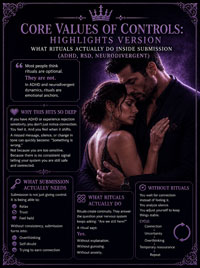
Someone living with ADHD may struggle with consistency while caring deeply about their partner.
Someone with a history of trauma may need additional reassurance before feeling emotionally safe.
Others may experience rejection sensitivity, anxiety, or different communication needs.
These realities aren’t flaws.
They’re important pieces of information.
Healthy partners become curious rather than critical.
They ask questions instead of making assumptions.
Understanding doesn’t eliminate challenges, but it often transforms the way those challenges are approached together.
Psychology Is About Awareness, Not Labels
The purpose of psychology isn’t to diagnose yourself or someone else.
It’s to become more aware.
The more you understand your own patterns, emotional needs, communication style, and reactions under stress, the more intentionally you can build relationships that support growth rather than repeat old wounds.
Healthy BDSM begins with understanding another person.
Exceptional BDSM begins with understanding yourself as well.
Continue the Series
Next: Pillar Three: Structure explores why clear expectations, boundaries, and intentional design create more freedom rather than less.
Go Deeper
Ready for the Next Step?
Whether you’re just beginning your journey or looking to strengthen an existing dynamic, these resources can help you build healthier, safer, and more intentional power exchange relationships.
New Here?
Download the Free Orion Starter Toolkit
Includes the Dynamic Health Assessment, Vetting Compatibility Assessment, Weekly Dynamic Review, and Ritual Builder Worksheet.
👉 https://orionsquill.com/orion-starter-toolkit/
Want Better Vetting Skills?
The Vetting Book
Learn how to identify green flags, recognize red flags, ask better questions, and make more informed relationship decisions.
👉 https://orionsquill.com/vetting/
Need More Structure?
The Structure Blueprint
Practical guidance on creating rules, rituals, protocols, expectations, and communication systems that support lasting dynamics.
👉 https://orionsquill.com/products/
Want Personal Guidance?
One-on-One Coaching & Mentoring
Get personalized support with vetting, communication, boundaries, relationship dynamics, structure development, and personal growth.👉 https://orionsquill.com/coaching/
#BDSM
#BDSMEducation
#Psychology
#PowerExchange
#AttachmentStyles
#EmotionalSafety
#HealthyRelationships
#TraumaInformed
#ADHD
#RelationshipPsychology
#SelfAwareness
#Communication
#Dynamics
#OrionsQuill
#SexyWordsmith