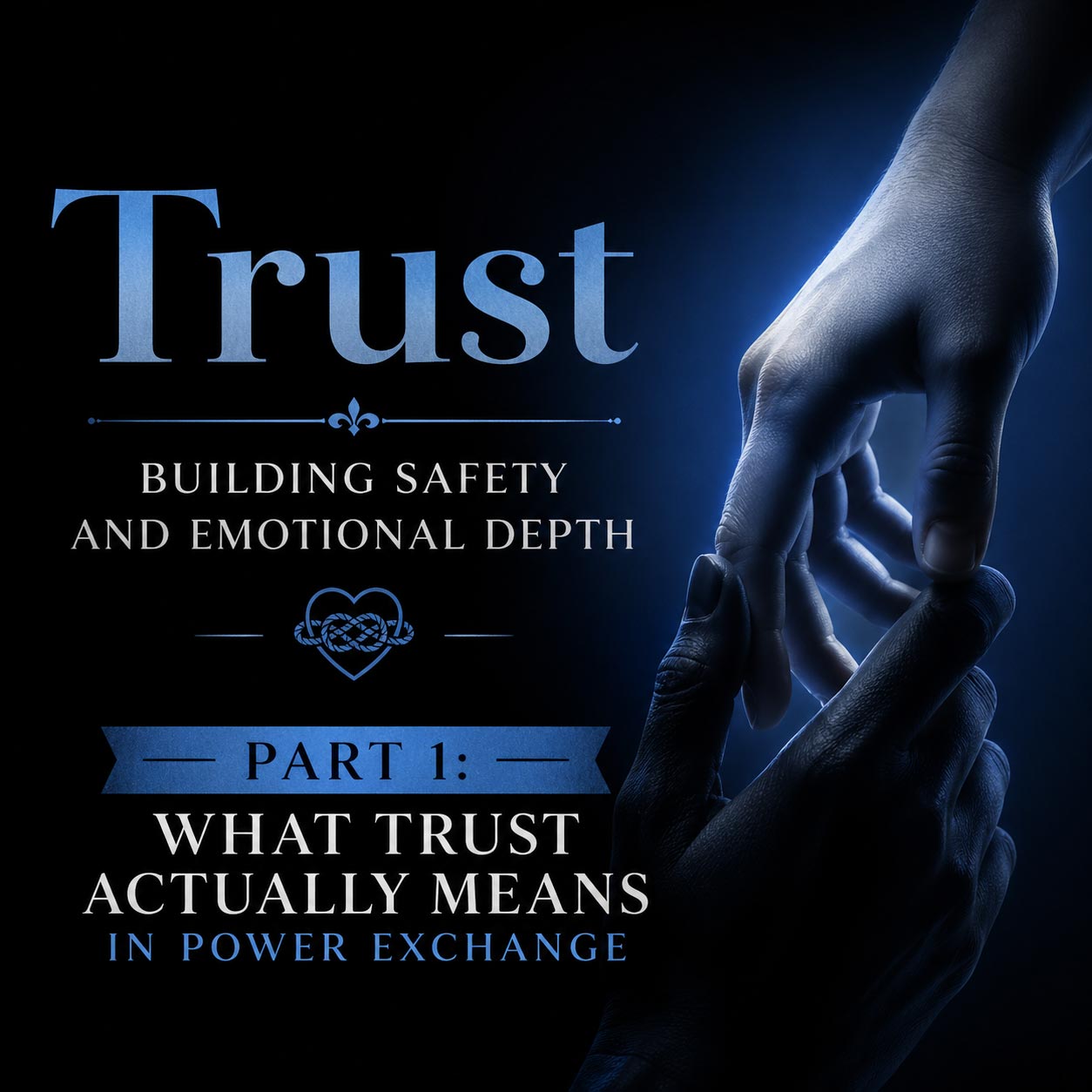
Trust is one of the most frequently used words in power exchange, yet it is rarely defined with clarity. People say “trust is everything,” but few take the time to understand what that actually means in practice.
Because trust is not a feeling alone. It is a structure. It is something built, reinforced, and experienced through consistent interaction over time.
In a D/s dynamic, trust is what allows power to be exchanged without fear. It is what allows vulnerability to exist without regret. And it is what separates a dynamic that feels safe and fulfilling from one that feels uncertain or unstable.
Without trust, everything else becomes fragile.
⸻
Trust Is More Than Reliability
Many people simplify trust down to one idea: reliability.
“Do what you say you’ll do.” While this is part of it, it is only the surface. Trust in power exchange goes deeper.
It includes:
Emotional safety
Respect for boundaries
Consistency in behavior
Integrity in communication
A Dominant who follows through on instructions but dismisses emotional needs is not building full trust.
A submissive who obeys but hides their truth out of fear is not operating in trust either.
Because trust is not just about action. It is about how those actions are experienced.
⸻
The Three Layers of Trust in D/s Dynamics
To understand trust clearly, it helps to break it into layers.
- Physical Trust
This is the most visible layer. It involves safety, consent, and the responsible handling of physical interaction. It answers the question:
“Am I safe with you physically?”
- Emotional Trust
This is where many dynamics either deepen or fail. Emotional trust is the ability to be seen, expressed, and received without fear of judgment, dismissal, or punishment. It answers the question:
“Can I be fully myself with you?”
- Relational Trust
This is built over time. It comes from patterns. From consistency. From knowing how someone will respond because they have shown you repeatedly. It answers the question:
“Can I rely on who you are, not just what you do?”
Strong dynamics do not rely on just one of these.
They develop all three.
⸻
Trust Is Built, Not Assumed
One of the most common mistakes people make is assuming trust too early.
Attraction is not trust.
Chemistry is not trust.
Intensity is not trust.
Trust is built through experience.
Through moments where:
Boundaries are respected
Communication is honest
Actions match words
And most importantly, through time.
This is why rushed dynamics often feel unstable.
They attempt to operate at a level of depth that trust has not yet supported.
And when something goes wrong, there is no foundation to hold it.
⸻
Trust and Vulnerability
Power exchange invites vulnerability.
But vulnerability without trust creates anxiety, not connection.
A submissive who offers vulnerability without feeling safe may begin to withdraw, people-please, or suppress their needs.
A Dominant who does not feel trusted may begin to overcompensate, control too tightly, or disconnect emotionally.
Trust is what makes vulnerability feel grounded instead of risky.
It allows both partners to lean into their roles fully, without constantly questioning whether they are safe to do so.
⸻
The Role of Consistency
Trust is not built through grand gestures.
It is built through consistency.
Small moments repeated over time:
Checking in
Following through
Responding with care
Maintaining emotional presence
These are the things that shape perception.
Over time, consistency becomes predictability.
And predictability becomes safety.
This is what allows both partners to relax into the dynamic.
⸻
Why Defining Trust Changes Everything
When trust is undefined, people rely on assumptions.
And assumptions create misalignment.
One partner may believe trust means obedience.
The other may believe it means emotional openness.
Without clarity, both can feel confused, disappointed, or even betrayed without understanding why.
Defining trust creates alignment.
It allows both partners to understand:
What trust looks like
How it is built
What behaviors reinforce it
What behaviors damage it
And once that clarity exists, everything becomes more intentional.
⸻
Closing Insight
Trust is not a starting point.
It is a process.
It is something that grows as two people show each other, again and again, that they are safe to be known, safe to be honest, and safe to engage in the depth that power exchange offers.
When trust is built with intention, a dynamic moves beyond roles and into something far more powerful.
Connection that is stable.
Vulnerability that is supported.
And a structure that can hold both intensity and growth.
⸻
Call to Action
If this shifted how you understand trust, you are only beginning to see what most dynamics are missing.
Inside my full education system, I break down exactly how to build trust, structure, and emotional depth in a way that creates real, lasting power exchange.