
There is a dangerous pattern that quietly destroys people inside D/s dynamics.
Especially submissives.
Especially the ones who feel deeply.
Especially the ones who learned somewhere along the way that love must be earned through usefulness.
So they perform.
They overgive.
Oversexualize.
Overaccommodate.
Overtolerate.
They become endlessly available.
Endlessly understanding.
Endlessly patient with people who give them fragments while demanding devotion in return.
And because the dynamic is wrapped in kink language, they mistake emotional starvation for submission.
But submission is not emotional self abandonment.
That is survival behavior disguised as devotion.
A lot of submissives are not actually asking:
“Does this person deserve my surrender?”
They are asking:
“How do I become valuable enough to keep?”
That question changes everything.
Because once your worth becomes tied to performance, you stop evaluating the relationship clearly.
You start negotiating against yourself.
You excuse inconsistency because “he’s busy.”
You tolerate emotional distance because “Dominants struggle with vulnerability.”
You silence your needs because “good submissives are low maintenance.”
You force yourself to endure dynamics that drain your nervous system because you think proving loyalty will eventually create security.
It rarely does.
Because people who benefit from your self abandonment almost never ask you to stop doing it.
And this becomes even more complicated for people with ADHD.
Especially those with rejection sensitivity.
Because inconsistency does not feel small to an ADHD brain.
It feels consuming.
The delayed reply.
The emotional withdrawal.
The hot and cold attention.
The sudden distance after intimacy.
An ADHD nervous system often interprets uncertainty as danger.
So instead of stepping back and evaluating whether the connection is healthy, many people begin working harder for reassurance.
More availability.
More sexual energy.
More emotional labor.
More proving.
This creates a brutal cycle where the submissive becomes increasingly emotionally attached while simultaneously becoming less emotionally safe.
And the hardest part?
Many people do not even realize they are doing it.
They think they are being devoted.
But devotion without self protection becomes depletion.
A healthy Dominant does not want you shrinking yourself to preserve the dynamic.
They do not want obedience built on fear of abandonment.
They do not want your submission fueled by anxiety, insecurity, or desperation for validation.
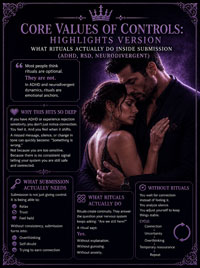
Real structure should create nervous system safety.
Not emotional confusion.
A healthy dynamic allows you to feel:
Seen.
Chosen.
Safe to communicate.
Safe to pause.
Safe to have needs.
Safe to say “this hurts me.”
Safe to exist outside of performance.
Because your value was never supposed to come from how perfectly you submit.
And this is where many people need to confront something uncomfortable:
Being desired is not the same thing as being valued.
Someone wanting access to your body does not automatically mean they are capable of holding your heart responsibly.
Someone enjoying your submission does not automatically mean they are equipped to lead it.
And someone calling themselves Dominant does not mean they understand emotional stewardship.
Titles are easy.
Consistency is rare.
Anyone can enjoy the fantasy of devotion.
Far fewer people can handle the responsibility of being trusted deeply.
That is why vetting matters.
Not just sexual vetting.
Emotional vetting.
Can they communicate during conflict?
Can they regulate themselves?
Can they handle vulnerability without withdrawal?
Can they offer reassurance without making you feel needy for asking?
Can they hold authority without creating fear?
Can they lead without making you disappear?
Those questions matter far more than how dominant someone sounds in messages.
Because sustainable D/s is not built on intensity alone.
It is built on emotional safety, consistency, communication, accountability, and structure.
Without those things, even the strongest chemistry eventually collapses under emotional instability.
And this is the truth many submissives desperately need to hear:
You are allowed to stop auditioning for love.
You are allowed to stop proving your worth through suffering.
You are allowed to stop romanticizing emotional unavailability as power.
You are allowed to require depth.
Consistency.
Care.
Communication.
Leadership.
Reassurance.
Presence.
Those needs do not make you weak.
They make you human.
The right dynamic will not require you to become smaller to maintain connection.
It will allow you to become more fully yourself inside safety.
That is what healthy submission actually looks like.
Not fear.
Not exhaustion.
Not confusion.
But trust strong enough that your nervous system finally stops preparing for abandonment.
Reflection Questions
• Are you expressing your needs clearly, or trying to earn care through performance?
• Does your dynamic create nervous system safety or constant anxiety?
• Are you being valued beyond your usefulness?
• Do you feel emotionally held, or emotionally managed?
• Are you choosing this dynamic freely, or fearing what happens if you stop giving?
Closing Thoughts
Submission should never cost you your identity.
A healthy Dominant does not ask you to erase yourself to make the relationship easier.
They help create the conditions where your nervous system can finally unclench.
Where your submission becomes intentional instead of desperate.
Where your devotion comes from trust instead of fear.
That is the difference between being consumed and being cared for.
And if you are constantly forced to question your worth inside a connection, the problem may not be your submission.
It may be the structure you are trying to survive inside.
CTA
Ask yourself honestly:
Am I being loved here…
or am I just being useful?
Sit with that answer longer than is comfortable.
Then ask yourself one more question:
What would change in my life if I finally believed my needs mattered too?
If this article resonated with you, share your thoughts, experiences, or reflections below. The conversations people avoid are often the ones that heal us most.