
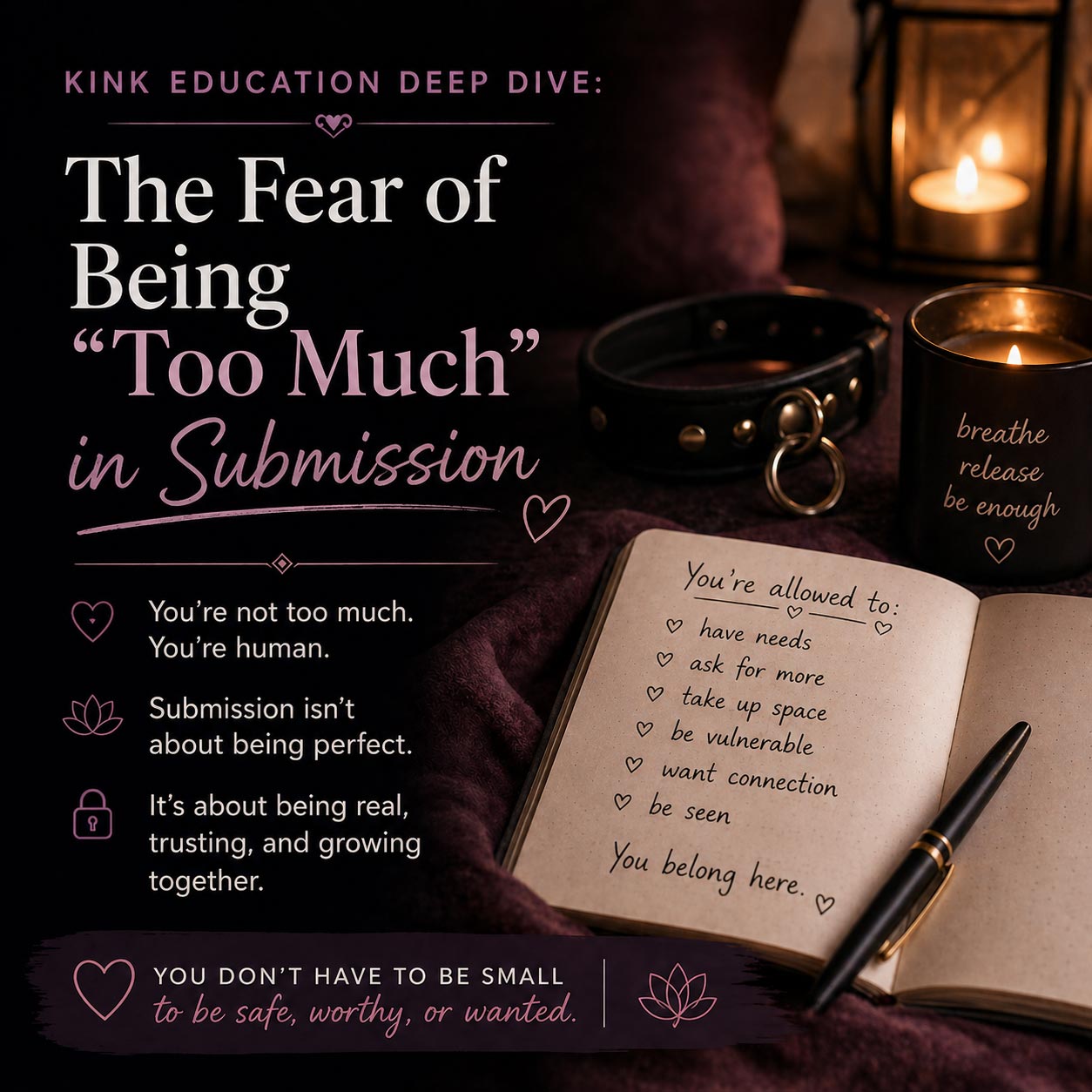
There is a quiet fear that many submissives carry, often without fully realizing it.
The fear of being:
Too emotional
Too needy
Too intense
Too reactive
Too much
Because of that fear, something subtle begins to happen.
They start to hold back.
Not all at once, but in small, controlled ways.
Until what they express is no longer the full truth of who they are.
Where This Fear Comes From
This fear rarely begins inside kink.
It usually starts much earlier.
In environments where emotional expression was dismissed, needs were labeled as excessive, or sensitivity was misunderstood.
Over time, this creates a pattern:
If I am fully myself, I will be too much.
So the person adapts.
They learn to minimize their needs, filter their reactions, and stay within what feels acceptable.
This is where masking begins.
Masking Inside Submission
Masking is presenting a version of yourself that feels safer, but is not fully authentic.
In submission, this can look like:
Saying “I’m okay” when you’re not
Holding back emotional reactions during scenes
Avoiding asking for reassurance
Suppressing needs to avoid being “difficult”
From the outside, this may look like easy or low-maintenance submission.
Internally, it often feels like tension, anxiety, and disconnection.
Because submission is not meant to be performance.
It is meant to be expression.
Rejection Sensitivity and the Fear Loop
For many, especially those with ADHD or certain attachment patterns, rejection sensitivity amplifies this fear.
Small shifts in tone can feel significant.
Silence can feel like withdrawal.
Neutral reactions can feel negative.
So the mind starts scanning constantly:
Was that too much?
Did I say too much?
Did I react wrong?
Instead of expressing freely, the submissive begins adjusting in real time, not based on their needs, but on perceived reactions.
What This Looks Like in Real Dynamics
This pattern is often invisible, but it shows up clearly in behavior.
Example: Emotional Expression
A submissive feels overwhelmed during a scene but stays quiet to avoid disrupting the moment.
The Dominant never sees their full state, and the submissive feels alone inside the experience.
Example: Need for Reassurance
After an intense interaction, the submissive needs grounding but says nothing to avoid seeming needy.
The need goes unmet, and the emotional drop deepens.
Example: Desire for Structure
The submissive wants more guidance but waits instead of asking.
Frustration builds, and the dynamic begins to feel unstable.
The Cost of Being “Less”
At first, masking feels like protection.
Over time, it creates disconnection.
Needs go unmet.
Communication becomes incomplete.
The dynamic is built on partial truth.
Eventually, something breaks.
Not because the dynamic was wrong, but because it was never fully honest.
What Healthy Submission Actually Requires
Healthy submission is not about being less.
It is about being known.
That includes your needs, your reactions, your emotional depth, and your intensity.
A Dominant cannot lead what they cannot see.
They cannot support what is hidden.
The Role of the Dominant
A skilled Dominant recognizes this pattern.
They do not reward silence.
They create space for expression.
This can look like asking direct questions, encouraging honest feedback, and responding to vulnerability without punishment.
Leadership is not just about control.
It is about creating safety for truth.
Practical Ways to Start Changing This
Change does not happen all at once.
It happens in small, intentional steps.
Name one real feeling
Instead of filtering everything, say something simple and honest:
“I’m feeling a little overwhelmed right now.”
Ask for one need directly
“I think I need a little reassurance right now.”
Notice your internal edits
When you think “I shouldn’t say that,” pause and ask why.
Debrief honestly
After interactions, share what felt good, what felt difficult, and what you needed but didn’t express.
These small shifts build trust over time.
Reframing “Too Much”
What if “too much” is not actually too much?
What if it is unmet needs, unseen depth, or unexpressed truth?
In the right dynamic, what feels like too much becomes something that is understood and held.
The goal is not to shrink.
It is to find a space where you do not have to.
Final Thought
The fear of being “too much” does not come from who you are.
It comes from where you were not fully received.
Submission is not about becoming smaller.
It is about becoming visible.
And the right dynamic will not be overwhelmed by that.
It will be built around it.
Continue the Work
If this resonated with you, you are starting to uncover one of the most important layers in power exchange.
Many dynamics do not fail from lack of desire.
They fail from lack of honest expression.
You can explore more deep dives and resources on my website, where I break down the psychology, structure, and communication behind real D/s dynamics.
You can also join the newsletter to receive upcoming articles, deeper breakdowns, and early access to new material.
I am also developing a structured kink education system designed to help you:
Understand your emotional patterns
Communicate needs clearly without fear
Build dynamics that are stable, honest, and sustainable
If you are ready to stop holding back and start building something real, make sure you are subscribed.
Because the difference between connection and disconnection is honesty supported by structure.